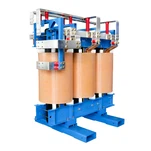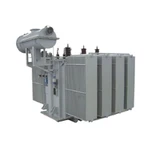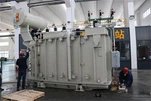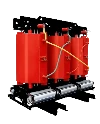


Why do transformer cores need to be grounded?
Transformer in operation, iron core and fixed iron core, winding metal structure, parts, components, etc. are in a strong electric field, under the action of electric field, they have a high potential to the ground. If the iron core is not grounded, there will be a potential difference between it and the grounded clamp and the fuel tank, etc., under the action of the potential difference, intermittent discharge may occur.
In addition, in the operation of the transformer, the winding has a strong magnetic field around, the iron core, metal structure, parts, components, etc., are in a non-uniform magnetic field, their distance from the winding is not equal, so the metal structure, parts, components and other magnetic field induction generated by the electromotive force size is also not equal, there is a potential difference between each other. Although the potential difference is not large, it can also break down a small insulation gap, so it may also cause a persistent trace discharge phenomenon.
Whether it is the intermittent discharge phenomenon that may be caused by the role of potential difference, or the continuous micro-discharge phenomenon that may be caused by the breakdown of a small insulation gap, it is not allowed, and it is very difficult to check the location of these intermittent discharges.
The effective solution is to ground the iron core and the fixed iron core, the metal structure, parts and components of the winding reliably, so that they are equal to the fuel tank in the geodetic potential. The core grounding of the transformer is one point grounding, and only one point grounding. Because the silicon steel sheets of the iron core are insulated from each other, this is to prevent the production of large eddy currents, therefore, it is necessary not to ground all the silicon steel sheets or multi-point ground, otherwise, it will cause large eddy currents and serious heating of the iron core.
The iron core of a transformer is grounded, usually by grounding any piece of silicon steel in the iron core. Although the silicon steel sheet is insulated, its insulation resistance value is very small, and the uneven strong electric field and strong magnetic field can make the high voltage charge induced in the silicon steel sheet flow to the earth through the silicon steel sheet from the ground, but it can prevent the eddy current from flowing from one piece to another. Therefore, as long as any piece of the silicon steel sheet of the iron core is grounded, then it is equal to the entire iron core is grounded.
It should be noted that the core of the transformer must be grounded at one point, not at two points, but not at multiple points, because multi-point grounding is one of the common faults of the transformer.
■ Why can't the transformer core be grounded at multiple points?
Because the transformer core laminate can only be grounded at one point, because if more than two points are grounded, a loop may be formed between the ground points. When the main track passes through this closing and loop, it creates a circulating current in it, causing internal overheating and causing an accident. The local molten iron core will form a short circuit fault between the iron chips, making the iron loss larger, which will seriously affect the performance and normal work of the transformer, and can only be repaired by replacing the core silicon steel sheet, so the transformer does not allow multi-point grounding can only have and only a little ground.
■ Multi-point grounding is easy to form circulation, easy to heat.
During the operation of the transformer, its iron core and metal parts such as clips are in a strong electric field, because electrostatic induction will generate a suspension potential on the iron core and metal parts, and this potential will discharge to the ground, which is of course not possible, so the iron core and its clips must be correctly and reliably grounded (except for the core bolt). The iron core allows only one point of ground, if there are two or more points of ground, the iron core will form a closed loop with the ground point and the earth. When the transformer is in operation, a magnetic flux will pass through this closed loop, which will create a so-called circulation, causing local overheating of the core, and even burning metal components and insulation.
To sum up: the iron core of the transformer can only be grounded at one point, not at two or more points.