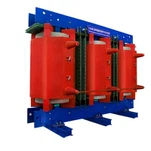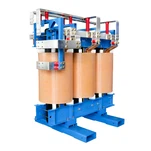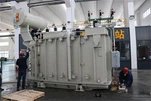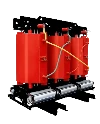


A dry-type transformer is a type of transformer that does not use any liquid for cooling. Instead, it relies on air to cool the transformer components. Here's a detailed explanation of how a dry-type transformer works:
Components of a Dry-Type Transformer
1. Core: The core is made of laminated steel sheets, which are stacked together to reduce energy losses caused by eddy currents.
2. Windings: There are typically two sets of windings: primary and secondary. The windings are made of copper or aluminum wire, which is insulated to prevent short circuits.
3. Insulation: Insulation materials such as epoxy resin are used to insulate the windings and other components.
4. Cooling System: This consists of air ducts and natural or forced air ventilation to dissipate heat.
Working Principle
1.Magnetic Induction: The primary winding of the transformer is connected to the AC power source. When an AC voltage is applied to the primary winding, it creates a varying magnetic field in the core.
2.Electromagnetic Induction: This varying magnetic field induces a voltage in the secondary winding according to Faraday's Law of Electromagnetic Induction. The voltage induced in the secondary winding is proportional to the ratio of the number of turns in the primary and secondary windings.
3.Voltage Transformation: The voltage can be stepped up or stepped down based on the turns ratio of the primary to the secondary windings. For example, if the primary winding has 100 turns and the secondary winding has 50 turns, the transformer will step down the voltage by a factor of 2.
Cooling Mechanism
1. Natural Air Cooling (AN): In this method, natural convection allows the heat generated in the transformer to be dissipated into the surrounding air. The design often includes ventilation ducts that promote airflow around the windings and core.
2. Forced Air Cooling (AF): This method uses fans or blowers to increase the airflow over the transformer components, enhancing cooling efficiency. This is typically used in transformers with higher power ratings.
Advantages
1.Safety: Dry-type transformers are safer than oil-filled transformers as there is no risk of oil leaks or fires.
2.Maintenance: They require less maintenance since there are no liquids to check or replace.
3.Environmental Friendly: They are more environmentally friendly because they don't use or release harmful insulating liquids.
Applications
Dry-type transformers are used in various applications, including:
1.Commercial Buildings: For electrical distribution within buildings.
2.Industrial Plants: To step down the voltage for machinery and equipment.
3.Renewable Energy Systems: In wind turbines and solar power installations.
4.Schools and Hospitals: Where safety and reliability are crucial.
In summary, a dry-type transformer operates by using electromagnetic induction to transfer electrical energy between its windings, with air cooling to manage the heat generated during this process.