


Distribution Transformer
Why Choose Us
Quality products
We offer high-quality power transmission and transformation equipment that meets international standards and customer specifications.
Cost-effective
Our products are competitively priced. We employ an efficient manufacturing process that reduces production costs and enhances customer value.
Professional team
Our team of engineers, technicians, and sales personnel has over ten years of experience in the manufacturing and supply of power transmission and transformation equipment.
Customer-focused
We prioritize customer satisfaction. We work closely with our customers to understand their requirements and provide tailor-made solutions to meet their needs.
What Is Distribution Transformer?
A distribution transformer is an electrical apparatus used to transform high-voltage electric power to a lower voltage so that it can be distributed to homes, businesses, and other settings. These transformers are responsible for reducing the voltage level and increasing the current level to enable safe and efficient delivery of power from the transmission system to end-users. Distribution transformers can be installed on poles, in underground vaults, or in metal enclosures mounted on concrete pads. They are essential components in the electrical grid, allowing electricity to be distributed through a variety of circuits and feeders to reach different areas and users.
-
 11 KV Distribution TransformerSpecifications:. Primary Voltage Ratings: 10kv. Secondary Voltage Ratings: 0.4kv. H.V. TAP RANGE: ±2×2.5%. CONNECTION TYPE: Dyn11. . Description:. Ryan can customize production according to customerAdd to Inquiry
 -
 22 KV Distribution TransformerSpecifications:. Primary Voltage Ratings: 22 KV. Secondary Voltage Ratings: 0.4 KV. High Pressure Tapping Range: ±2×2.5%. Connection Group Symbol: Dyn11. . Description:. Ryan’s 22kV oil-immersedAdd to Inquiry
 -
 33 KV Distribution TransformerSpecifications:. Primary Voltage Ratings: 35-38.5 KV. Secondary Voltage Ratings: 3.15-10.5 KV. High Pressure Tapping Range: ±2×2.5%. Connection Group Symbol: Yd11. . Description:. Ryan’s 35kVAdd to Inquiry


- Tel: +86-513-88781828
- Fax: +86-513-88837088
- Email: Ryancustomerinquiry@redq.cc
- Add: No.229, Huanghai West Road, Haian City, Jiangsu Province, China.
Efficient energy transfer: Distribution transformers are highly efficient in transferring electrical energy across different voltage levels with minimal loss.
Cost-effective: These transformers are cost-effective and require low maintenance, making them suitable for use in commercial and residential areas.
Safe: Distribution transformers are designed to be safe as they have proper insulation and grounding systems, which prevent electrical hazards.
Easy to install: They are relatively easy to install, which saves time and money on installation.
Easy to operate: These transformers are easy to operate and are controlled by a few settings, making it easier for the operators to monitor and control its operation.
Provides a constant supply of electricity: Distribution transformers provide a constant supply of electricity to the end-users.
Reliable: Distribution transformers are reliable and have a long life span, making them ideal for use in various applications.
Applicable in various sectors
They find application in various sectors, including commercial, residential, industrial, and rural electrification.
No interruptions in power supply
It ensures that there are no interruptions in power supply, which can be critical in areas requiring uninterrupted power supply.
Reducing carbon footprint
These transformers are highly efficient and reduce the carbon footprint by minimizing energy loss, thereby contributing to environmental protection.

Single phase
A single-phase transformer works on a single-phase power supply and contains a single winding on the primary and secondary sides. They are mainly employed in single-phase electrical power networks.
Three phase
A 3-phase transformer works on a three-phase power supply, and both primary and secondary windings have three sets of windings. This is a more expensive method, and it is applied in the high-voltage power network.
Pad mounted
The term 'pad mount transformer' has become a generic expression for a low kVA ground-mounted transformer with its protection and even switching options. These transformers are connected to underground utility distribution lines.
Pole mounted
The pole-mounted transformers are mounted on a power pole at the height of the overhead cables. These transformers are widely used in rural areas, ranging from 16 kVA to 100 kVA. They are small in size and easy to mount on single-pole structures.
Distribution transformers are the most essential part of power distribution systems as they efficiently transfer electrical energy between different voltage levels.The core, made of special electrical steel (cold rolled grain oriented), enables a smooth path for magnetic flux. Windings, comprising insulated copper or aluminum wires, facilitate voltage transformation.
Insulation materials ensure electrical safety by preventing short circuits and isolating the windings from the core. These sophisticated components play a crucial role in voltage regulation and power transmission, making them vital for reliable and safe power distribution networks worldwide.
Transformers are fundamental in balancing and controlling electricity flow, ensuring a consistent supply of power to various industries and households. Without these, the efficient distribution of electricity across different grids would be challenging, hindering the modern functioning of societies and economies.


Transformer losses occur the whole time the transformer is powered. The current flows in a transformer winding and the alternating magnetic field in the core contributes to most transformer losses. Losses can be classified into two categories.
No load losses
Transformer no-load loss is often called core loss or iron loss. The no-load losses in a transformer are primarily caused by losses in the core steel. However, it is the combined losses caused by eddy current, hysteresis, stray eddy current and dielectric losses that make up the no-load losses
The size of the no-load loss is related to factors. These include transformer capacity, magnetic circuit structure, silicon steel sheet quality and depend on the unit loss of iron core material. With the voltage of the power supply being constant, the size of no-load loss remains the same value.
Load losses
The losses produced in the core are called no-load losses, meanwhile, the losses associated with the coils are called load losses. Load losses are sometimes referred to as copper losses. The term copper losses are used regardless of whether the windings are made of copper or another conductor (typically aluminium). These losses are made up of heat losses and I²R (current squared times resistance) losses. This loss is due to the primary and secondary winding resistance and is directly proportional to load, so if that increases the losses increase.
Check the load characteristics
To know the transformer's rating, it is always essential to check the load characteristics when buying distribution transformers. The load characteristics of a distribution transformer include the type of load and the fluctuation of the voltage. When talking about the type of load, it can be intermittent load or continuous load.
Check the voltage rati
The voltage ratio of a distribution transformer depends on the load characteristics and the applications. The voltage ratio of a distribution transformer is calculated by taking the ratio of primary voltage to secondary voltage or high voltage to low voltage. The size of the distribution transformer also depends on the voltage ratio. The higher the voltage ratio, the bigger the size of the distribution transformer will be due to the increase in the number of turns in the primary winding.
Consider the phase configuration
Some applications require single-phase configuration. Whereas some applications require a three-phase configuration, especially industrial applications. The phase configuration helps in determining the primary winding phases and the secondary winding phases. The distribution transformers with single-phase configurations are mostly used for residential purposes only. It is advisable to choose the distribution transformer's phase configuration according to the applications.
Check the efficiency
When selecting distribution transformers one must look for efficiency. An efficient transformer helps in reducing power loss by converting the voltage in the right way. It not only helps in saving power but also helps in saving costs. The transformer will work efficiently only when the parts and the components used in that are of optimum quality. That is why it is also advisable to buy from top manufacturers of distribution transformers.
The Significance of Distribution Transformer Maintenance
Distribution transformers play a pivotal role in electrical systems, facilitating the efficient transfer of electrical energy from one voltage level to another. They can be found at power generation plants, substations, and even within various electrical appliances we use daily. Due to their widespread application, it is imperative to maintain transformers to ensure their reliability and safety.
Periodic inspections and routine maintenance are indispensable for transformers, as they help detect and address potential issues before they escalate, thereby extending the operational lifespan of these critical components. By conducting regular maintenance, transformers can operate in a safe and reliable condition, minimizing the risk of costly downtime and equipment failure.
Maintenance of Distribution Transformer


Check the temperature of the transformer
See whether the upper oil temperature of the transformer is normal or near or over the maximum allowable limit from the thermometer. When there is a significant anomaly between the temperature that glass thermometer indicates and that the pressure thermometer indicates, it is necessary to find out whether the meter is not accurate or the oil temperature is abnormal.
The check of the oil level
Check whether the temperature of transformer oil storage cabinet is normal and if there is false oil level and oil leakage phenomenon, whether oil level of high voltage bushing and the color of oil is normal and whether bushing has oil leak phenomenon.It is necessary to find out the cause when the oil level indication is not normal. And it is also necessary to pay attention to the path of the oil level indicator and we must ensure that there is no accumulation at the entrance.
Check the sound
Check whether there is abnormal comparison between the electromagnetic sound of the transformer and the previous sound. Staff are usually accustomed to the normal noise of the transformer, and if there is an abnormal sound, they will find it easily.
Check the insulation on the top cover of the transformer
See whether the supporting insulator surface of the outline casing and extraction electric conduction is clean, whether there is a rupture or electric discharge or other defects.
Check the bolt joint that leads the conductor whether has superheating phenomeno
Check the change of the visual temperature wax sheet and the discoloring paint or directly measure it by the infrared thermometer flexibly. When there is a cable terminal box, the oil leakage of the cable head should also be checked.
Special Tests of Distribution Transformer
Sound testing
The sound generated by a transformer is affected by the core geometry, flux density, tank design, and the quality of assembly of all the transformer components into a completed unit. Sound tests are made with the unit powered at 100% and 110% of rated voltage under no-load conditions.
Temperature tests
Core losses and coil losses are the primary sources of heating within the transformer. Our transformers are guaranteed to have an average coil winding temperature of no more than 65 C rise over ambient air temperature when operated at rated voltage and load conditions. The temperature test is performed to determine the thermal characteristics of the transformer and to verify that they are within design limits.
Factors to Consider When Selecting a Distribution Transformer
Power requirements
One of the primary factors to consider when selecting a distribution transformer is the power requirements of your application. This includes the required voltage and current levels, as well as the frequency of the ac power source. Transformers are designed to convert ac power from one voltage level to another, and choosing the right transformer with the appropriate power rating is essential for ensuring that your equipment operates correctly.
Efficiency
Efficiency is another crucial factor to consider when selecting a transformer. A more efficient transformer will convert more of the input power into the desired output power, resulting in less energy waste and reduced operating costs. The efficiency of a transformer can be affected by factors such as the quality of the core materials, the design of the windings, and the type of cooling used.
Load characteristics
The load characteristics of your application will also affect the selection of the transformer. This includes the type of load (inductive, capacitive, or resistive), the level of harmonics, and the overall power factor of the load. Different types of loads require different types of transformers, and selecting the wrong transformer can result in reduced efficiency, increased heat, and potential damage to the equipment.
Environmental conditions
The environmental conditions in which the transformer will operate are also an essential consideration. Transformers can generate heat, and the ambient temperature of the environment can affect their performance. In addition, transformers can be affected by humidity, dust, and other environmental factors. Transformers that will be used in harsh environments such as outdoors or in industrial settings may require additional protection or special designs to ensure optimal performance.
Type of distribution transformer
Distribution transformers come in different types, including step-up transformers, step-down transformers, isolation transformers, autotransformers, and more. Each type of transformer has its own unique characteristics and advantages, and selecting the right type of transformer is essential for ensuring that your equipment operates correctly.
Size and weight
The size and weight of the transformer are also essential factors to consider when selecting a distribution transformer. The size of the transformer will depend on the amount of power it needs to handle, and the weight of the transformer will depend on the type of core materials used. It is important to ensure that the transformer you select is appropriately sized and can be easily installed in your application.
Our Factory
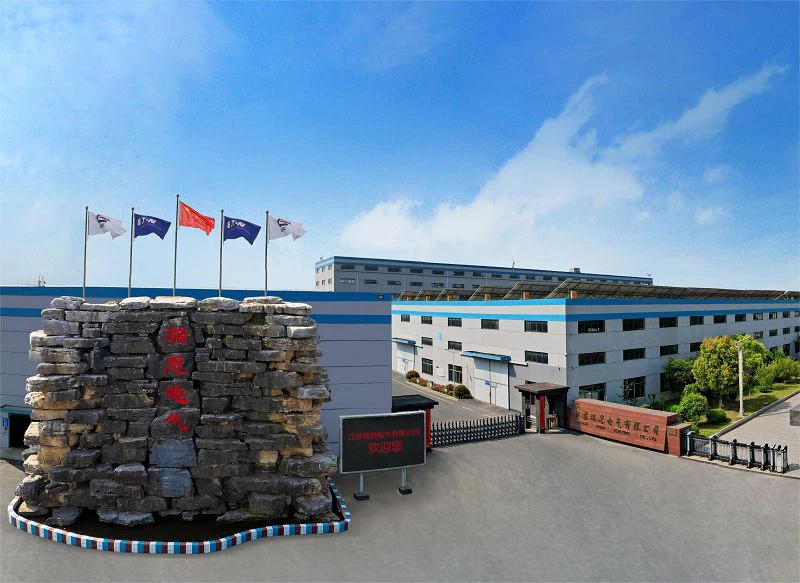
Established in 2007,Jiangsu Ryan Electric Co., Ltd is a new high-tech enterprise specialized in manufacturing electric transmission and transformation equipment and has over 20 series products including cast resin dry-type series transformers (Specification:10kV, 20kV, 35kV and 110kV), oil-immersed transformers (Specification:10kV, 20kV, 35kV,66kV and 110kV), pad mounted series transformers (ANSI pad-mounted transformer and IEC prefabricated transformer) and complete sets of high and low voltage electrical switch control equipment (KYN61-40.5,KYN28-12, HXGN, MNS and GGD).
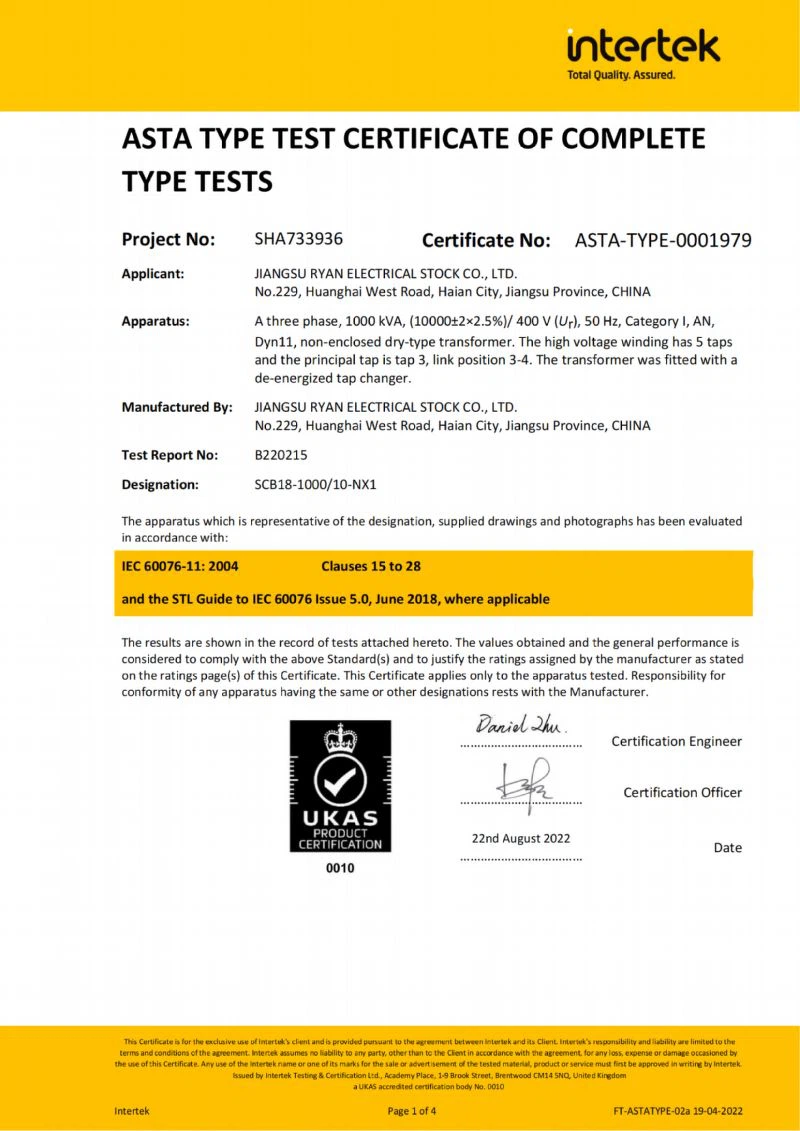
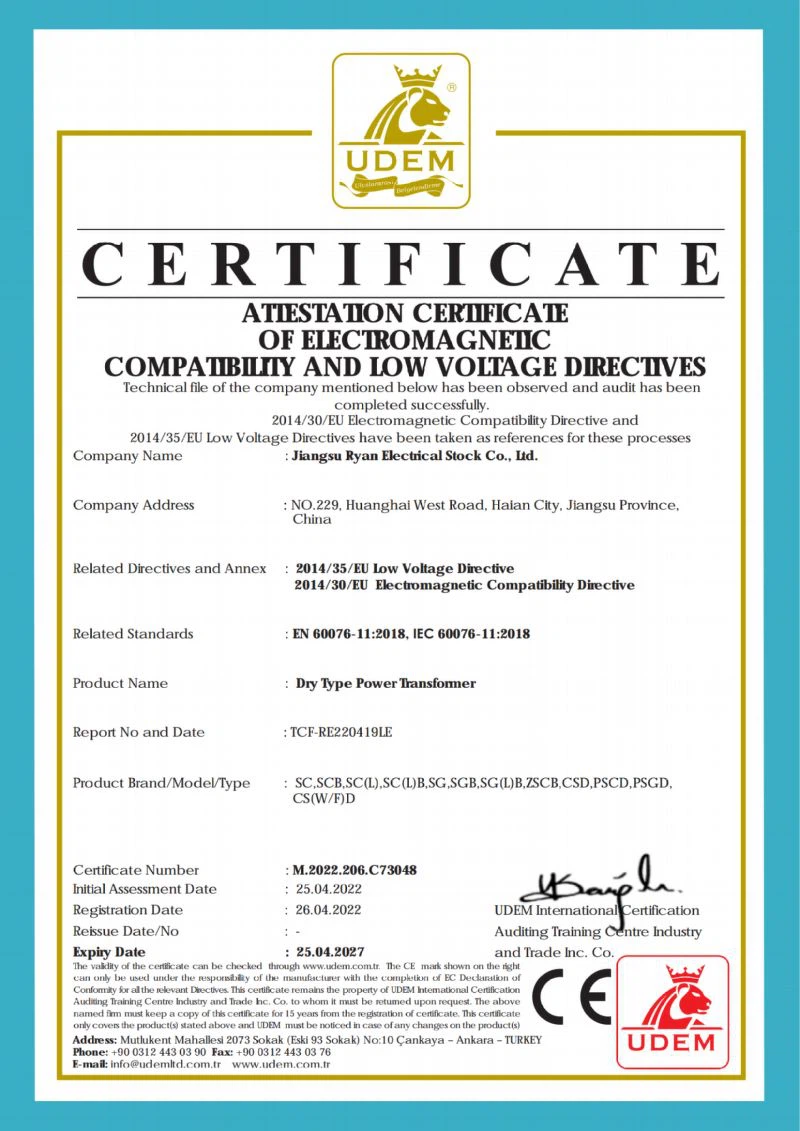
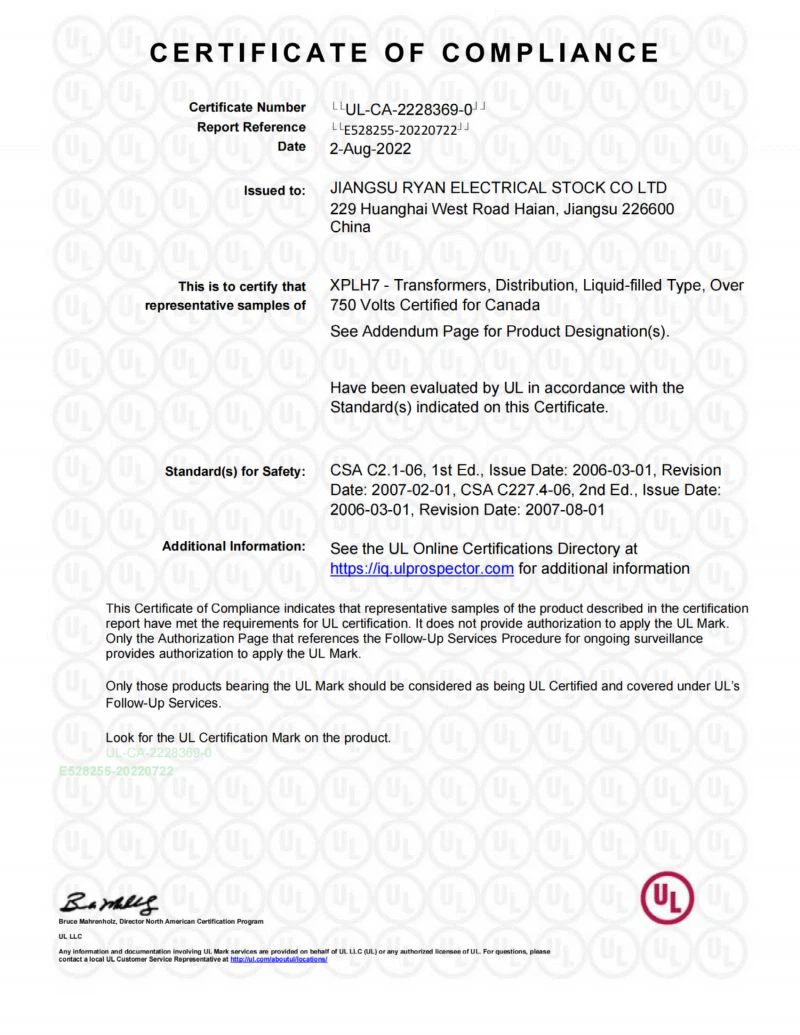
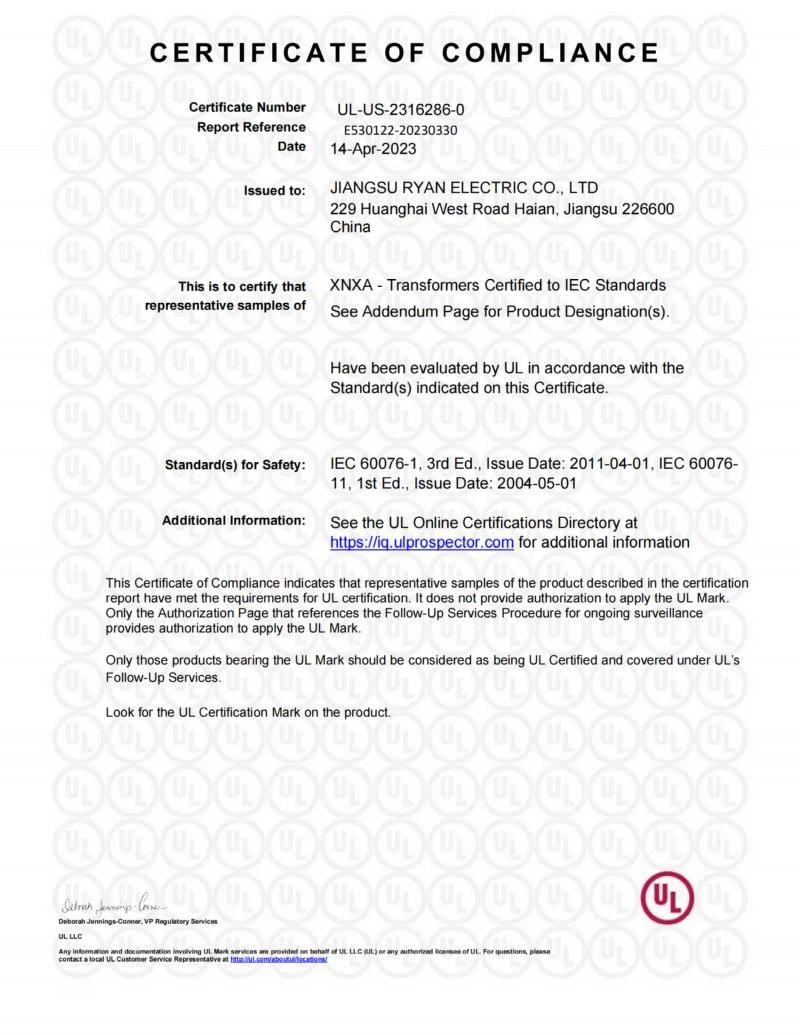
Our Certificate
FAQ
As one of the most professional distribution transformer manufacturers and suppliers in China, we're featured by quality products and good service. Please rest assured to buy customized distribution transformer from our factory.
three phase dry type transformer, 33 KV Distribution Transformer, Distribution Transformer