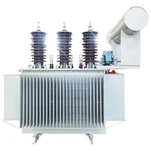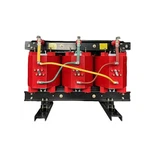


Parallel operation of transformers refers to connecting the primary windings of two or more transformers to the same power source and their secondary windings to the same load, allowing them to operate together. This setup improves reliability, flexibility, and load-handling capacity in power systems. Here's a detailed explanation:
1. Conditions for Parallel Operation
To ensure stable parallel operation of transformers, the following conditions must be met:
(1) Voltage Ratio Equality:
The rated voltage ratios of all transformers must be equal to prevent circulating currents and increased losses.
Typically, the voltage ratio tolerance is within ±0.5%.
(2) Equal Short-Circuit Impedance (Relative Values):
The short-circuit impedance of all transformers must be similar (usually within a 10% deviation).
Unequal impedance leads to uneven load sharing, with transformers having lower impedance carrying a higher load.
(3) Same Phase Angle:
The phase angles of the transformer windings must be identical to ensure the correct phase relationship.
A phase angle mismatch causes phase displacement and makes parallel operation impossible.
(4) Same Connection Group:
The transformers must have the same connection group (e.g., Dyn11, Yyn0) to ensure voltage phase alignment.
Different connection groups result in phase differences, preventing parallel operation.
(5) Appropriate Rated Capacity Ratio:
The capacity ratio of transformers in parallel should not be too large, typically not exceeding 3:1.
A significant difference in capacity can lead to uneven load distribution and possible overloading of smaller transformers.
2. Advantages of Parallel Operation
(1) Increased Reliability:
If one transformer fails, others can continue supplying power.
(2) Flexible Load Distribution:
Transformers can be switched on or off according to load demands, improving energy efficiency.
(3) Increased Capacity:
Parallel operation enhances the system's total power supply capacity to meet larger load requirements.
(4) Ease of Maintenance:
In a parallel setup, one transformer can be taken offline for maintenance without disrupting power supply.
3. Disadvantages of Parallel Operation
(1) Circulating Current Issues:
Parameter mismatches (e.g., voltage ratio, impedance) can cause circulating currents, increasing losses.
(2) Uneven Load Sharing:
Different short-circuit impedance values may lead to uneven load distribution, causing potential overloading.
(3) Increased Complexity:
Monitoring and coordinating multiple transformers require more advanced control systems.
4. Load Sharing in Parallel Operation
When transformers operate in parallel, load sharing depends on their short-circuit impedance:
I1:I2=Z2:Z1I_1 : I_2 = Z_2 : Z_1I1:I2=Z2:Z1
I1,I2I_1, I_2I1,I2: Load currents of the two transformers.
Z1,Z2Z_1, Z_2Z1,Z2: Short-circuit impedance of the two transformers.
For example, if the short-circuit impedance of two transformers is 5% and 10%, the load current sharing ratio will be 10:5=2:110:5 = 2:110:5=2:1.
5. Steps for Parallel Operation
(1) Verify Parameter Compatibility:
Ensure the transformers' rated voltage ratio, short-circuit impedance, and connection group meet the parallel operation criteria.
(2) No-Load Parallel Connection:
First, connect the transformers without any load to check if circulating currents are within acceptable limits.
(3) Gradual Loading:
Gradually increase the load while monitoring the load current distribution and temperature rise.
(4) Real-Time Monitoring:
Continuously monitor the operating conditions to detect overload or anomalies promptly.
6. Example Calculation
Assume two transformers:
Transformer A: 500 kVA, 5% impedance.
Transformer B: 250 kVA, 5% impedance.
Since the short-circuit impedance is equal, the load is shared according to the capacity ratio:
Transformer A carries 500500+250×100%=66.7%\frac{500}{500+250} \times 100\% = 66.7\%500+250500×100%=66.7% of the load.
Transformer B carries 250500+250×100%=33.3%\frac{250}{500+250} \times 100\% = 33.3\%500+250250×100%=33.3% of the load.
If you need further details on specific calculations or design recommendations, feel free to ask!