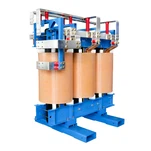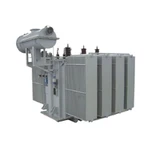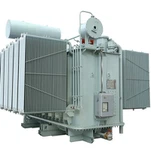


Last month an EPC buyer in Lagos sent us an RFQ for six 1,000 kVA transformers, 33/0.415 kV, and left the transformer vector group column empty. The rest of the document was meticulous - loss guarantees, oil level, tap range, even paint colour. Only the connection was missing, and it was the one line that decides whether those six units can ever run in parallel with the two Dyn11 transformers already feeding the industrial estate.
The blank column is common. Vector group codes look like manufacturer jargon - Dyn11, Dyn5, YNd11 - until a unit arrives on site and cannot be paralleled, or an LV neutral runs hot on a Friday afternoon. This guide explains what the code actually says, which vector groups dominate real distribution projects, and the three places a wrong connection costs money. If you write RFQs or approve transformer test reports, the clock-number code deserves the same attention as kVA.
What a transformer vector group actually tells you
A transformer vector group is a code that describes two things: how the high-voltage and low-voltage windings are connected - delta, wye, or zigzag - and their phase displacement, the angular offset between the HV and LV voltage phasors. The code uses capital letters for the HV winding and lower case for the LV winding: D or d for delta, Y or y for wye, Z or z for zigzag. A lower-case n means the wye neutral is brought out to a bushing or terminal.
The number at the end is a clock position, and one hour on the clock equals 30 electrical degrees. Dyn11 therefore means a delta HV winding, a wye LV winding with the neutral brought out, and an LV that lags the HV by 30 degrees - clock position 11. It is the compatibility statement of the machine, and it belongs on every enquiry document, next to kVA and voltage.
The vector groups you will meet on real projects
| Vector group | Winding configuration | Phase relationship | Typical application |
|---|---|---|---|
| Dyn11 | HV delta, LV wye, neutral out | LV lags HV by 30° | Four-wire LV distribution across Asia, the Middle East, Africa and parts of Europe |
| Dyn1 | HV delta, LV wye, neutral out | LV leads HV by 30° | Utilities that standardize the opposite rotation - check before paralleling |
| Yyn0 | HV wye, LV wye, neutral out | No displacement (0°) | Small radial networks with limited single-phase unbalance |
| YNd11 | HV wye (neutral out), LV delta | 330° displacement | Generator and solar step-up units where the delta traps harmonic currents |
| Dyn5 | HV delta, LV wye, neutral out | 150° displacement | Rare alone; dangerous beside a Dyn11 - the two sit 180° apart |
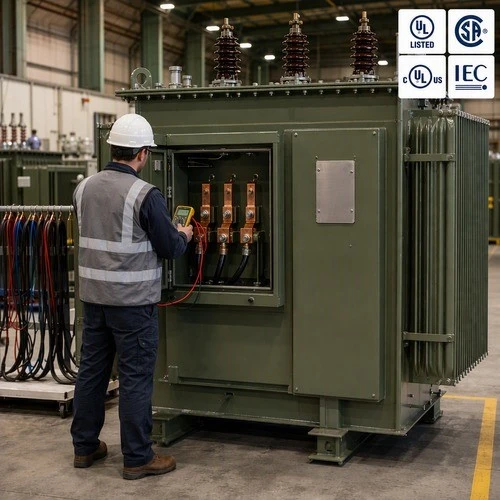
Most of the pad-mounted and skid-mounted units we ship to Southeast Asia, the Middle East and Africa are Dyn11, because four-wire LV networks need a wye secondary with a brought-out neutral and a delta primary that absorbs zero-sequence current from unbalanced phases. In North America the same delta–wye arrangement is usually drawn as "30°" with a connection diagram instead of a clock number - the same machine, a different labelling convention, and exactly where cross-border orders go wrong. A spec that says only "delta–wye" hides the question that decides parallel compatibility: is the unit a Dyn1, a Dyn5 or a Dyn11?
Phase displacement and the 30-degree clock
Every hour on the clock is 30 electrical degrees. A Dyn11 secondary lags its primary by 30°; a Dyn1 leads it by 30°; a Dyn5 carries a 150° displacement. Spread across the clock, two units can sit 60° apart - a Dyn1 and a Dyn11 - or a full 180° apart. When two transformers feed the same bus, their secondary voltage phasors must point the same way; if they do not, the units fight each other and circulating current flows even at no load. The Dyn11 vs Dyn5 question comes up whenever a second unit must share a bus with an existing one - they sit 180° apart, so the answer is no, not without reconnection or a new transformer.
Parallel operation needs four things to line up: the same voltage ratio, vector groups that produce the same resultant displacement, impedances close enough to share load proportionally - within roughly 10 percent of each other is the working rule - and similar short-circuit capability. Ratio and %Z usually get checked. The transformer vector group is the compatibility check people skip, because it is the one item that cannot be fixed on site.
Three places a wrong group bites: grounding, unbalance, harmonics
A wye secondary with a brought-out neutral is what lets a distribution transformer supply single-phase loads phase-to-neutral. When the unit also carries a delta winding, zero-sequence currents from unbalanced phases and ground faults have a closed path to circulate, and the transformer handles the unbalance without core saturation or an overheated neutral. That is why delta–wye (Dyn) units are the default for four-wire LV systems. A Yyn0 unit - wye on both sides, no delta - has no such path: heavy single-phase loading shifts the neutral point, and neutral current becomes a hard design limit instead of an afterthought. If your network relies on zigzag or wye-connected grounding transformers for earth-fault return, that is a separate winding choice, covered in our guide to grounding transformers.
The delta winding also gives third-harmonic (triplen) currents - 3rd, 9th, 15th - a place to circulate instead of flowing back toward the source. Buildings packed with VFDs, UPS systems and EV chargers generate them continuously. That is the same phenomenon the K-factor rating handles on dry-type units, which we explain in our K-factor transformer rating guide; on a liquid-filled unit with a delta winding, part of the job is done by the connection itself.
One confusion worth clearing: vector group is not phase rotation. Rotation - ABC versus ACB - is about which way the phasors turn; the vector group is about where the LV phasor sits relative to the HV phasor. Both are checked at site, but only rotation can be fixed by swapping two cables.
What a factory checks before the group goes on the nameplate
In our factory the transformer vector group is verified electrically on every unit, not assumed from the drawing. The phase-relation test - part of the routine test sequence described in IEEE C57.12.90 and in IEC 60076-1 - energizes the transformer at reduced voltage and compares the HV and LV phasor positions against the declared connection. A Dyn11 unit wired as a Dyn1 shows up as a 60-degree error on the test set, and it is caught before oil goes in, not after commissioning.
Because we build to both IEC clock codes and North American practice, our UL and CSA listed designs ship with the connection diagram and angular displacement written in the format the destination market expects - the translation happens in engineering, not on site. As an official joint-venture partner of Eaton since 2023, we follow the same discipline Eaton applies in its own transformer programmes: the vector group is fixed at the design review, stated on the tender drawing, and proven in the routine test report.
If you are adding a transformer beside an existing unit, send us the old test report with your enquiry - we will confirm the two can be paralleled before you commit, not after. Reach us through ryantransformers.com.
Six spec lines that prevent the costliest mistake
Put these lines in your next RFQ and vector-group problems mostly disappear:
- Vector group written out in full - Dyn11, Dyn5 or YNd11 - not "delta–wye" alone.
- LV neutral brought out to a terminal, sized for the unbalanced-load current you actually expect.
- Parallel condition stated: if new units must run with existing transformers, attach the existing test report to the RFQ.
- Connection drawing and phase-relation test results required inside the routine test report.
- Phase sequence at the site (ABC or ACB) confirmed with the switchgear designer.
- Test standard named - IEC 60076-1 or IEEE C57.12.90 - so your inspector knows what to accept.
Getting the vector group wrong can cost months of schedule and a second round of factory testing - the Dyn11 vs Dyn5 trap is the most common version of it. Getting it right costs one line in the RFQ. Send your load data and the test report of any existing unit to Ryan Electric through ryantransformers.com, and we will confirm vector group, neutral rating and parallel compatibility before you place the order.
About the Author - This article was written by the engineering and sales team at Jiangsu Ryan Electric Co., Ltd. (Ryan Electric), a transformer manufacturer founded in 2007 with a 120,000 m² production base, more than 180 sets of manufacturing and testing equipment and 37 patents, and an official joint-venture partner of Eaton since 2023. The company supplies liquid-immersed and dry-type transformers to utility, renewable and industrial clients across North America, Southeast Asia, the Middle East and Africa, with UL and CSA listed designs available for North American projects.