

A buyer in Ohio emailed us a nameplate photo last month: a 1,000 kVA oil-immersed unit built in 2005, offered by a dealer at USD 28,000, "inspected and ready to ship." We asked three questions before giving our opinion. Where is the factory test report? When was the last dissolved-gas analysis run? And why did the previous owner retire the unit? The dealer could not produce a single document. We told the buyer exactly what to demand before signing - and that list became the backbone of this article.
Here is the uncomfortable part of writing this as a manufacturer: we do not make money when you walk away from a deal. But when lead times stretch toward two years and prices keep climbing, the used transformer market looks like the fastest way out of a hole - and too many buyers jump in without the file work that separates a bargain from a liability. This guide covers what our engineers check before we would ever recommend a used transformer, whether the unit is headed for a substation, a solar site, or a temporary bypass.
Why Used Transformers Are Suddenly Everywhere
Start with the numbers. Wood Mackenzie's September 2025 supply outlook, covered in POWER magazine's January 2026 analysis, puts U.S. power-transformer demand 119% above 2019 levels, distribution-transformer demand up 34%, and average power-transformer lead times near 128 weeks. The same report notes that more than half of U.S. distribution transformers - roughly 40 million units - are already beyond their expected service life. That aging fleet is now retiring into a resale market that has never been hotter, and IEEE Spectrum's reporting on the transformer shortage traces the same squeeze back to years of underinvestment in grain-oriented steel and factory capacity.
The result is a secondhand channel that barely existed a decade ago. Utilities decommission surplus units, brokers buy them at auction, and listings for refurbished and surplus equipment now sit next to factory orders. Prices on used iron have climbed with everything else. The real issue is not whether used transformers for sale exist - it is whether anyone can prove what those units actually are.
Start with Paper: Four Documents Before You Look at the Tank
In our factory, we are asked to evaluate secondhand units almost every month, and the answer is always the same: start with the file, not the iron. Four documents decide whether a refurbished transformer is worth your time - and a seller who cannot produce them is telling you something.
Factory test report. Routine tests per IEEE C57.12.00 - turns ratio, impedance, no-load and load loss, and dielectric tests - prove the unit met its design targets when it left the factory. A missing report means you are buying an unknown.
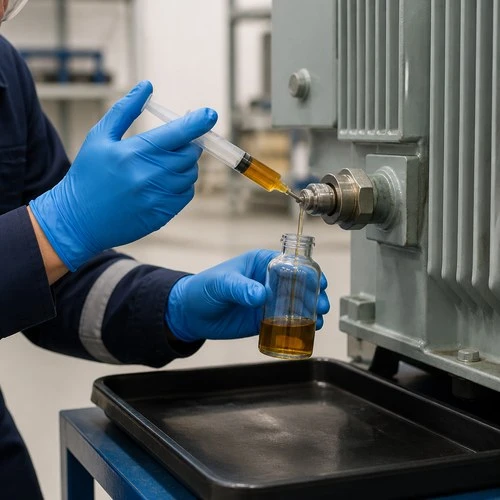
Oil analysis and transformer testing history. For oil-immersed units, ask for DGA records interpreted under IEEE C57.104, plus moisture, dielectric strength, and acid number. Furan testing estimates paper insulation aging - degree of polymerization - without opening the tank.
Service and retirement record. Why did the previous owner take it out of service? An efficiency-driven replacement is one thing; a unit retired after a through-fault or flooding is another. Ask for load history if it exists.
Efficiency compliance. In the United States, distribution transformers manufactured after January 1, 2016 must meet DOE minimum efficiency levels under 10 CFR Part 431, with a stricter tier effective January 1, 2026 and another step in 2029. Older units often fall below today's minimums, and some utilities and local authorities will not accept them for permanent installation.
A seller who cannot produce these four documents rarely has anything else worth seeing. When buyers send us only a nameplate photo and ask "is this a good deal," our answer is always the same: the deal is only as good as the paper behind it.
Then Look at the Iron: What Field Checks Actually Catch
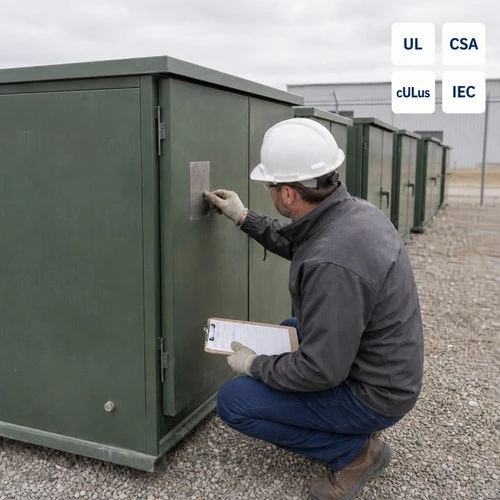
When the paperwork is clean, the physical inspection starts. We look at tank bottom welds first - corrosion starts where water collects, and a fresh coat of paint can hide a decade of pitting. Bushing surfaces get checked for cracks and tracking marks, gaskets for oil weep, radiators and cooling fins for impact damage. On pad-mounted and dead-front units, we check terminations and compartment seals, because that is where moisture gets in.
If the seller allows access, field transformer testing adds real information. Turns ratio and winding resistance checks confirm the core-and-coil assembly; insulation resistance (megger) flags moisture problems; and sweep frequency response analysis (SFRA) is the one test that exposes winding movement from a rough move or a through-fault. Oil dielectric strength and moisture content round out the picture. These tests do not replace a factory report, but they tell you whether the unit survived whatever happened after it left the factory.
One caution from our inspection floor: we once reviewed a "gently used" unit where every surface was freshly painted - including the hardware around the nameplate. A unit that was supposedly stored indoors does not need that much paint. If the story does not add up, it usually does not add up.
When Buying Used Actually Makes Sense
None of this means the used transformer route is always wrong. There are three situations where it can be the right call: a temporary bypass while a new unit is being built; a non-critical, lightly loaded application where a documented unit can be tested before energizing; and an emergency spare when the alternative is weeks of downtime. In those cases, budget for independent testing and treat the unit as as-is. Just remember that the used transformers for sale today are priced like the scarce commodity they have become - the discount is no longer what it was in 2019.
For permanent, critical installations, the comparison usually lands on the side of a certified new unit. Weigh it on the same axes we use in the factory:
Test documentation: used units often ship with incomplete or missing reports; a certified new unit includes a full routine test report per IEEE C57.12.00.
Efficiency compliance (US): an older unit may fall below current DOE minimums under 10 CFR 431; a new unit meets the current DOE efficiency tiers.
Warranty and support: used equipment is usually as-is with no factory support; new equipment carries a factory warranty and engineering backup.
Remaining life: a used unit's remaining life is unknown without paper and testing; a new unit starts with a full design life, typically 30+ years.
Certification: an original UL or CSA listing often does not transfer with a resold unit; new equipment is certified to UL, CSA, cULus, or IEC for your target market.
What a Certified New Unit Buys You
We build oil-immersed and dry-type transformers in a 120,000 m² facility with more than 180 production and test stations, and since 2023 we have worked as an Eaton joint-venture partner, which means our quality system is reviewed against one of the industry's strictest house standards. Every unit we ship leaves with a complete test report, certification files, and drawings - the same package we tell used-unit buyers to demand, because we would not accept less ourselves. Depending on your target market, certification is available under UL, CSA, cULus, or IEC schemes.
We are not going to pretend the wait does not exist. What we can do is make it predictable: tell us the rating, the standard, and the commercial operation date early, and we will lock a production slot around it. That planning conversation - not a last-minute hunt for a miracle unit - is what has kept more than one North American project on schedule this year.
Before You Sign, Send Us the Nameplate
Whether you end up buying new or used, the first step costs nothing: send us the nameplate photo and whatever documentation you have, and our engineers will tell you what the unit is worth and what it will take to make it dependable. Reach the team directly at ryantransformer@redq.cc. A fifteen-minute review has saved buyers more than one expensive mistake - and that is a claim we are happy to be judged on.
About the Author: This guide was written by the engineering team at Ryan Electric (Jiangsu Ryan Electric Co., Ltd.), an Eaton joint-venture partner and UL/CSA-certified transformer manufacturer based in Jiangsu, China. Since 2007, the company has served utility, data center, solar, storage, and industrial clients across North America, Southeast Asia, the Middle East, and Africa.