

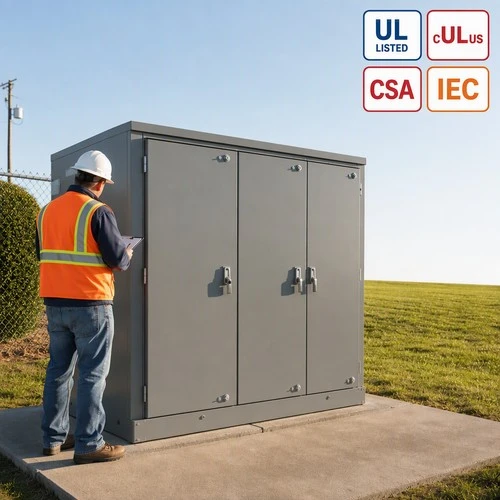
Last spring, a distributor in Georgia called us two hours after the truck left his yard. The pad mounted transformer enclosure looked right in the photos - matte gray, clean welds, a current UL file number. What his utility customer's incoming inspector found took ninety seconds: a door handle that opened with a standard hex key, hinge pins that lifted out with pliers, and a coating chip behind the latch that had already started to bloom rust. The unit was rejected before anyone checked the windings. That rejection was not about kVA, impedance, or losses. It was about enclosure integrity - and it is why we now walk every North American order through IEEE C57.12.28 before it ships.
What IEEE C57.12.28 Requires of a Pad Mounted Transformer Enclosure
IEEE Std C57.12.28-2014, officially titled "IEEE Standard for Pad-Mounted Equipment - Enclosure Integrity," sets conformance tests and requirements for above-grade pad-mounted enclosures that contain apparatus energized above 600 volts and that the public can reach: pad-mounted transformers, switchgear, metering, and voltage regulators. In plain language, it is the rulebook for the steel cabinet that keeps a utility's live parts away from children, landscapers, and anyone else walking past the fence. The official scope is public - you can read it on the IEEE SA page for C57.12.28-2014.
Two things live inside the standard. First, mechanical integrity: tamper-resistant hardware, latches, and door systems that stop casual access with common tools. Second, the outdoor coating system that has to survive decades of sun, salt, and rain. Neither shows up on an electrical test report. That is why first-time buyers are usually surprised: their RFQ says nothing about it, but the utility specification attached to the RFQ almost always does. The sentence you will see is short: "The pad mounted transformer enclosure shall comply with IEEE C57.12.28."
Tamper Resistance: What a Utility Inspector Checks First
The most common question we get from contractors in Texas is the same one inspectors ask: how does this door stay closed when no lock is on it? A pad-mounted transformer sits at the edge of a parking lot or a backyard, accessible by design to utility crews - which means the hardware has to stop everyone else. The tamper-resistance requirements translate into concrete details: no exterior fastener removable with common hand tools, hinges that cannot be lifted off, a handle that accepts a padlock, and a latch that holds the door shut even when the padlock is absent.
Three details show up on every inspection sheet we have seen:
Penta-head bolts. Five-sided fasteners that need a special socket. We ship a matching penta socket tool with every North American unit, because the contractor will ask for one on day one.
Three-point latching. Doors that engage at the top, middle, and bottom, so a pry bar at one corner cannot pop the whole door open.
Galvanized or stainless hardware. Hinges, hinge pins, and bolts that will not fuse with rust after two coastal winters.
We build the cabinet from cold-rolled steel around 3 mm (11-gauge) thick and reinforce the door frame, because enclosure rigidity is what keeps the latches aligned for twenty years. None of this is exotic. It is simply what the standard demands and what a utility inspector expects to see on the first pass.
The Coating System: ANSI 61 Gray That Has to Earn Its Keep
Walk any North American utility yard and the color is the same: ANSI 61 light gray. The standard does not stop at the color. The enclosure coating system must pass accelerated weathering - salt spray and UV exposure - plus scratch and adhesion checks, so the finish survives the 30-year life of the unit rather than the 3-year warranty. The test method most spec writers name is ASTM B117, the standard practice for operating salt spray (fog) apparatus. Coastal utilities are the strictest: one hour of salt fog in the test chamber is roughly the message their coastal air sends the cabinet every day for years.
In our factory, every pad-mounted enclosure destined for North America is powder-coated, and our coating system is validated with a 1,000-hour salt spray test per ASTM B117 plus UV cycling - the same discipline coating suppliers use to qualify their own systems. We also salt-spray sample panels from production batches, not just the first article. A pinhole that appears in week six of testing is a coating failure we can fix before the unit leaves, not after a utility finds it on a pad in Florida.

How Enclosure Integrity Fits with UL and CSA Listings
Buyers often assume one certification covers everything. It does not. A UL listed pad mounted transformer - or a CSA-certified unit for Canada - proves the electrical design meets the UL 1561/1562 or CSA C22.2 No. 47 safety requirements: insulation, short-circuit behavior, temperature rise, and the rest. Enclosure integrity is a separate requirement, usually written into the utility's own specification, and it points to IEEE C57.12.28 by name. A unit can carry a valid UL file and still fail an incoming inspection on enclosure details, exactly as the Georgia unit did.
Here is the part most buyers miss: the enclosure section of a North American utility spec is often longer than the electrical section. It names the coating color, the tamper-resistance class, whether dead-front construction is required, and which padlocking provisions the door must accept. When a buyer sends us only a datasheet, we ask for the utility spec before we quote - because quoting to the datasheet and shipping to the spec are two different jobs. We have quoted UL listed pad mounted transformers where the enclosure section ran longer than the electrical section, and that is completely normal.
What We Verify Before a Pad-Mounted Unit Leaves Our Factory
Ryan Electric has manufactured distribution and pad-mounted transformers in Jiangsu since 2007, in a 120,000 m² facility with 180+ sets of production and test equipment, and we have been an Eaton joint venture partner since 2023, with UL, CSA, IEEE, and DEKRA certification work in our portfolio. Because our pad-mounted output is built for North American utilities, enclosure integrity is a gate in our process, not an afterthought - every cabinet that carries a UL or cULus mark for the US or Canada goes through the same enclosure discipline.
Before a pad-mounted unit is crated, a QC inspector works through the checklist below - the same items a utility receiving inspector will check on the other side of the ocean:
Penta-head security bolts + padlockable handle - tamper resistance required by IEEE C57.12.28; verified with the supplied penta socket on every unit.
Door system with 3-point latching - keeps the door sealed even without the padlock; shim-and-force test on every door.
ANSI 61 powder coating system - must survive salt spray and UV exposure; 1,000-hour ASTM B117 salt spray on production samples.
Nameplate and enclosure marking - traceability at utility receiving inspection; cross-checked against UL file and PO.
We also photograph the enclosure details - hardware, hinges, coating, nameplate - and attach the photos to the shipping documents. In our experience that file folder is worth more than any letter of guarantee when a receiving inspector has questions at the gate.
Send Us Your Utility Spec Before You Order
The cheapest enclosure fix is the one made before steel is cut. If your next project needs a pad mounted transformer enclosure that will pass a North American utility inspection, send us the utility specification along with your rating - voltage class, kVA, and the standard named in the spec. Our engineers will confirm the enclosure and coating requirements, tell you exactly what the certification file does and does not cover, and quote accordingly. Browse the three-phase pad mounted transformer product page for reference ratings, or reach the team directly at ryantransformer@redq.cc with your spec attached.
About the Author: This article was written by the engineering team at Ryan Electric (Jiangsu Ryan Electric Co., Ltd.), an Eaton joint venture partner and UL/CSA/IEEE-certified transformer manufacturer in Jiangsu, China, serving utility, EPC, and contractor clients across North America, Southeast Asia, the Middle East, and Africa.