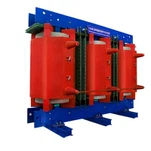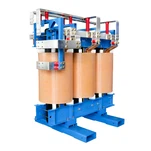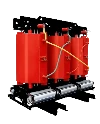


When designing Cast Resin Dry Type (CRT) Transformers, selecting the correct K-factor is essential for performance, safety, and longevity-especially in environments with high levels of harmonic distortion. Among the common options, K4 and K13 are frequently specified for transformers serving nonlinear loads such as data centers, industrial automation, or medical equipment.
What Is a K-Factor in Transformers?
The K-factor measures a transformer's ability to withstand the heating effects of harmonic currents without exceeding temperature limits. A K4-rated transformer can handle moderate levels of harmonics, while a K13-rated transformer is designed for much higher harmonic loads, often found in facilities with extensive use of variable frequency drives (VFDs) or computer equipment.
Impact on Copper Winding and Manufacturing
One of the most critical differences between K4 and K13 transformers lies in the copper winding design. To meet K13 standards, the transformer must use thicker copper foil or conductors to handle the increased thermal stress caused by harmonic currents. This often requires larger and more powerful copper foil winding machines. In some cases, standard manufacturing equipment may not support winding the thicker copper needed for high-capacity K13 designs, making production more complex and costly.
Design Considerations and Limitations
For high-capacity transformers such as 4500kVA CRT units, achieving a K13 rating may not be feasible if the available foil winding machines cannot accommodate the required conductor size. In such cases, engineers may recommend using a K4-rated design or evaluating system-level harmonic mitigation strategies.