

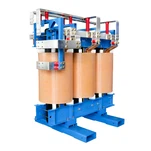
Dry-type transformers are more and more widely used in modern power systems, and are chosen by many users, and now we will explain the relevant explanations of dry-type transformers.
Dry-type transformers do not use oil to start, so there are no fire, pollution and a series of problems occur. Compared with oil-immersed transformers, dry-type transformers have the characteristics of good safety performance, low loss, and low noise. According to the use environment and protection requirements, dry-type transformers can choose to use different shells, generally using IP23 protective shells, which can prevent some solid foreign objects, mice, snakes, cats and other small animals from entering, causing failure to the equipment.
The safe operation and service life of dry-type transformers, a large commitment depends on the safety and reliability of transformer winding insulation, winding temperature exceeds the insulation tolerance temperature to make insulation damage, is one of the main reasons for transformers can not work normally, so the monitoring of the operating temperature of the transformer and its alarm control is very important. The temperature control system used, when the transformer temperature reaches 80 °C, the dry-type transformer automatically starts the air cooling system to cool the transformer; When the transformer temperature reaches 130°C, the alarm signal starts to alarm; When the transformer temperature reaches 150°C, the transformer automatically trips.
The overload capacity of dry-type transformers is related to the ambient temperature, the load situation before overload (initial load), the insulation and heat dissipation of the transformer, and the heating time constant.
The cooling methods of dry transformers are divided into free air cooling (AN) and forced air cooling (AF). With natural air cooling, the transformer can operate continuously for a long time at rated capacity. When forced air cooling, the transformer capacity output can be increased by 50%. It is suitable for intermittent overload operation, or emergency overload operation, because the load loss and impedance voltage increase is large during overload, and it is in a non-economic operation state, so it should not be put in long-term continuous overload operation.

Decipher Dry Converters
Jul 05, 2023

Send Inquiry
Latest News


Contact Us
- Tel: +86-513-88781828
- Fax: +86-513-88837088
- Email: Ryancustomerinquiry@redq.cc
- Add: No.229, Huanghai West Road, Haian City, Jiangsu Province, China.