

Underground Distribution Transformers: How to Specify Submersible Units for Vaults and Network Systems
When a specification arrives with a single line in the notes section - "transformer may be submerged during storm events" - three things change: the tank, the bushings, and the paperwork. Everything else in the datasheet stays the same, which is exactly why the line gets missed. Utilities are now buying far more underground distribution transformers than they were five years ago, and most of the specification templates still in circulation were written for a unit sitting on a concrete pad above grade.

Why Underground Distribution Transformer Specs Are Changing Fast
Roughly 20% of the U.S. electric distribution system runs underground today, and the largest investor-owned utilities are pushing that number up through multiyear programs. In its June 2026 review of undergrounding strategy, POWER reported that Xcel Energy has about 19,000 miles of distribution line underground in Colorado - roughly half its system in that state - and plans 50 more miles in high fire-risk areas by the end of 2027 at an estimated $3.12 million per mile, while noting that underground construction can cost 5 to 10 times more than overhead. The full analysis is on the POWER grid strategy report (https://www.powermag.com/growing-grid-strategy-undergrounding-power-lines-to-withstand-weather/). Florida Power & Light has moved more than half of its distribution system underground as of mid-2025, and Pacific Gas and Electric is working toward a 10,000-mile undergrounding goal.
Utilities pay that premium for reasons that survive a cost review. A buried cable cannot start a wildfire, cannot be hit by a falling tree, and cannot drop a live conductor into a street after a vehicle impact. The U.S. Department of Energy and Berkeley Lab concluded that substantially reduced vulnerability to extreme weather and wildfire is a key advantage of underground transmission and distribution lines. Regulators have followed: California requires its largest utilities to file 10-year undergrounding plans prioritized by wildfire risk, and Virginia lawmakers asked state commissioners to study undergrounding this year under data center growth pressure.
For a transformer buyer the consequence is concrete. When a circuit goes underground, the transformer moves off the pad and into a vault, a submersible housing, or a network position below the sidewalk. An above-grade unit cannot simply be relocated into that space.
What "Submersible" Actually Means - IEEE C57.12.24 in Plain Language
Submersible transformers for underground duty are defined by IEEE C57.12.24-2023, the active standard for three-phase, liquid-immersed, self-cooled, 60 Hz units rated 3750 kVA and smaller, with high voltages of 34 500 GrdY/19 920 V and below and low voltages of 600 V and below, equipped with separable insulated high-voltage connectors. The standard covers electrical, dimensional, and mechanical characteristics and takes the safety features of that construction into consideration; the scope is published on the IEEE C57.12.24 standard page (https://standards.ieee.org/ieee/C57.12.24/7512/).
The history explains the design intent. The 2000 edition of the same standard was titled Underground-Type Three-Phase Distribution Transformers 2500 kVA and Smaller, and it described units generally used for step-down service from an underground primary cable supply and suitable for occasional submerged operation. That phrase - occasional submerged operation - is the line to hold onto. A C57.12.24 unit is built to survive a vault flooding during a storm and keep running afterwards. It is not a permanently immersed device, and treating it as one is how utilities end up with water in the oil and a dissolved gas analysis result they cannot explain.
Submersible versus pad-mounted: what actually differs
| Feature | Above-grade pad-mounted unit | Below-grade submersible unit |
| Enclosure | Dead-front compartment, tamper-resistant doors | Sealed tank, no accessible compartment |
| High-voltage interface | Air-insulated bushings inside a compartment | Submersible bushings or wet-rated separable connectors |
| Cover | Bolted, lockable, ventilation louvers | Welded or fully gasketed, controlled bolt torque |
| Mounting | Concrete pad above grade with clearance rules | Vault floor or direct burial, confined space entry |
| Cooling | Self-cooled, ambient near street temperature | Self-cooled, vault ambient above street temperature |
Five features separate a genuine submersible build from a standard unit with a coat of paint on it:
- A sealed tank with a welded or fully gasketed cover and no exposed compartment.
- Wet-rated separable insulated connectors in place of the air-insulated bushings used above grade.
- Documented gasket compression and bolt torque, because the tank is the pressure boundary.
- A tank grounding provision sized and positioned per the standard, typically a two-hole pad near the low-voltage end.
- A corrosion system designed for wet concrete and soil, with coating thickness specified in microns or mils and sacrificial anodes where the utility requires them.
Vault Heat, Ambient Correction, and the Thermal Margin You Think You Have
An underground distribution transformer is designed against the standard ambient envelope for distribution units - an average of about 30 °C with a maximum near 40 °C. A below-grade vault has no wind, limited ventilation, and walls that hold heat. On a 38 °C afternoon the air around the tank runs hotter than the street above it, and a self-cooled, liquid-immersed unit has no fan to switch on when that happens.
This is where the loading physics matter. IEEE C57.91, the guide for loading mineral-oil-immersed transformers, uses a reference hottest-spot temperature of 110 °C for a 65 °C-rise insulation system, and industry practice treats insulation life as halving for roughly every 6 to 8 °C above that reference - see the IEEE C57.91 loading guide (https://standards.ieee.org/ieee/C57.91/5297/). A vault that runs 10 °C above the assumed ambient is not a marginal site condition. It is a permanent change to how fast the insulation inside that unit ages.
Four specification moves recover most of that margin:
- Specify 55 °C rise instead of 65 °C rise where ventilation is poor. You pay for additional copper and core, and you get thermal headroom that no fan or sensor can add later.
- Ask for an ambient-corrected rating table, built on the measured vault air temperature rather than street data from the nearest weather station.
- Require an oil temperature gauge as a minimum, plus provision for a winding temperature sensor and a communication port if the utility plans monitoring after commissioning.
- Fix the vault itself: ventilation sized against the unit losses, drainage that works under storm conditions, and no storage of other equipment in the same chamber.
Network Systems: Protectors, Spot Networks, and Secondary Voltage Choices
A large share of downtown underground systems are secondary networks: several transformers feeding a common low-voltage grid so that any single unit can be removed from service without dropping load. In that position the network transformer works with a network protector, defined by IEEE C57.12.44, whose function is to automatically connect and disconnect a network transformer from a secondary spot or grid network - see the IEEE C57.12.44 standard page (https://standards.ieee.org/ieee/C57.12.44/4939/). Eaton publishes a useful plain-language primer on network protector fundamentals (https://www.eaton.com/ca/en-gb/products/utility-grid-solutions/network-protector-solutions/network-protectors--fundamentals-of-network-protectors.html).
The specifier's takeaway is mechanical rather than theoretical. The protector mounts on or immediately adjacent to the transformer secondary, so the tank's low-voltage bushing arrangement, the available mounting space, and the housing all have to be coordinated from the first drawing. A transformer built for a radial feed will not accept a network protector, and fitting one inside a vault after the fact is a crane job, not a field modification.
Secondary voltage follows the same logic. Classic four-wire network secondaries are 208Y/120 V and 480Y/277 V; spot networks serving a single large building often run at 480 V with a medium-voltage primary in the 13.8 kV to 27.6 kV range. Confirm with the utility whether the installation is a spot network or a grid network before the transformer is ordered. It changes both the protector and the network transformer design, and it is very difficult to change after the vault is poured.
Compliance Paperwork: DOE 2029, Certification Marks, and the Nameplate
Liquid-immersed submersible transformers usually fall inside the federal definition of a distribution transformer, and that definition now carries a date. Under 10 CFR 431.192 a distribution transformer has an input line voltage of 34.5 kV or less, an output line voltage of 600 V or less, operation at 60 Hz, and a capacity of 10 kVA to 5000 kVA for liquid-immersed units. The amended energy conservation standards for those products must be met on and after April 23, 2029, with efficiency values certified at 50 percent per-unit load. The compliance date and rule history are set out on the DOE distribution transformers page (https://www.energy.gov/cmei/buildings/distribution-transformers) and in the regulation text at eCFR 10 CFR Part 431 Subpart K (https://www.ecfr.gov/current/title-10/chapter-II/subchapter-D/part-431/subpart-K).
One detail catches buyers out. The exclusion list in the regulation includes sealed transformers, which some engineers assume covers a sealed vault unit. It does not: the same section defines a sealed transformer as a dry-type transformer designed to remain hermetically sealed under specified conditions of temperature and pressure. A sealed liquid-immersed unit does not leave the standard by that route, and the efficiency documentation still has to be produced.
Canadian projects add the other half of the package. Utilities north of the border work to the Canadian Electrical Code and expect CSA certification on the unit and on the separable connectors; CSA C227.4 is the reference standard for three-phase, pad-mounted, liquid-filled distribution transformers with separable insulated high-voltage connectors, listed in the CSA Group store (https://www.csagroup.org/store/product/2700379/). It pays to work with a UL listed transformer supplier who can hand over the DOE efficiency documentation together with the routine test report, rather than three emails and two weeks later.
What We Check in the Factory Before an Underground Unit Ships
Ryan Electric has manufactured oil-immersed distribution and power transformers since 2007, and since 2023 we have been an Eaton joint venture partner. Our Jiangsu plant covers 120,000 m² with more than 180 sets of production equipment and 37 patents, and our portfolio carries UL, CSA, IEEE, DEKRA, CNAS, and CE certification. Equipment for vault and network duty goes through the same routine test bay as our pad-mounted work, with five additional checks as a UL listed transformer supplier package:
- Tank pressure and leak soak - hold time, pressure drop, and the dry film thickness of the coating measured on the finished tank rather than on raw steel.
- Bushing and separable connector fit-up - the connector interface is a system, so we assemble it dimensionally before the unit leaves the bay.
- Cover gasket compression and bolt torque - recorded flange by flange, because the tank is the seal.
- Ratio and impedance verification against the nameplate - with the certificate attached, because network units must parallel correctly.
- Nameplate and document package - certification mark, temperature rise, percent impedance, efficiency level, serial number, and the routine test report in one file.
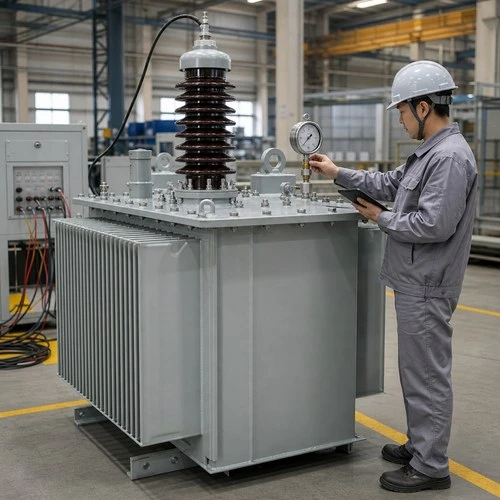
Underground distribution transformers leave our plant with that package, but field mistakes still cost utilities a second crew visit more often than manufacturing defects do. The recurring ones: leaving a vault open through a rain event before the unit is set; failing to dewater the vault floor; damaging the tank coating with an unprotected sling; backfilling before the acceptance test; and specifying for occasional submersion while operating the unit in a chamber that stays wet all year.
Send Us the Vault Drawing Before You Pour the Concrete
If your next project puts an underground distribution transformer below grade, the cheapest time to have the conversation is before the vault is designed. Vault dimensions, ventilation, drainage, protector mounting, and secondary voltage all determine what the transformer has to be, and every one of them is expensive to change afterwards. Send us the vault drawing, the load data, and the certification target through ryan-transformers.com and our engineers will come back with a tank drawing, an ambient-corrected rating, and a compliance checklist matched to your utility's requirements.
About the Author: This article was written by the engineering team at Ryan Electric, an Eaton joint venture partner and UL/CSA-certified transformer manufacturer in Jiangsu, China, supplying oil-immersed and dry-type transformers to utility, data center, and industrial projects across North America, the Middle East, and Southeast Asia.