

Where Transformer Oil Leaks Actually Start
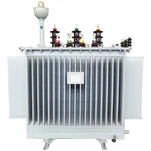
Last March a utility planner in Alberta sent us four photographs of the same unit: a 1,000 kVA pad-mounted transformer, four years in service, with a dark weep line running down the tank from the radiator flange. His question is the one we hear most often about transformer oil leaks - is this cosmetic, or do we book an outage? The stain itself answers half of that. What it does not tell you is where the oil is actually coming from.
Transformer oil leaks rarely begin with a hole in steel. They begin at the joints, and specifically at the elastomer gaskets that seal them. Tank cover, bushing adapters, radiator flanges and valve stems account for the overwhelming majority of the weeps we find during final inspection in our own plant, and the same four zones dominate the field failures our service engineers are asked about. A welded tank wall simply does not start weeping at four years.
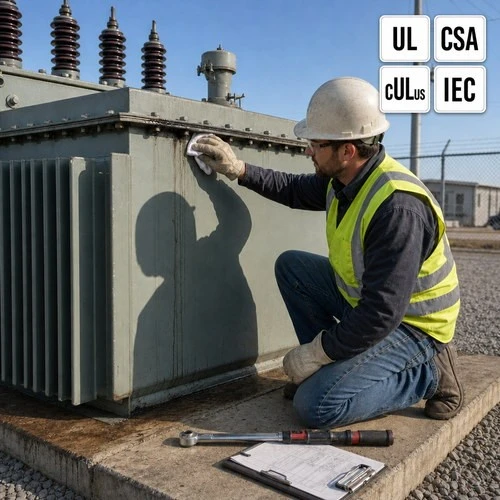
A liquid-filled transformer is not one vessel. It is a stack of bolted joints holding back a fluid that expands and contracts far more than the steel around it. The cover gasket alone can run six metres on a 1,000 kVA unit, which means it has to be compressed evenly at every bolt, across a span that changes shape a little every time the oil heats up.
| Zone | What fails first | Why it is vulnerable |
| Tank cover / main gasket | Elastomer takes a permanent set and the joint loses clamp load | Longest joint on the unit, widest temperature swing, hardest to load evenly |
| Bushing turret and adapter flanges | Gasket hardening, corrosion at the flange face | Sits closest to the winding leads, so it sees the severest thermal cycles |
| Radiator and valve flanges | Gasket relaxation, corroded hardware | Many small joints, thin flanges, continuous vibration from fans and pumps |
| Drain, filter and relief valve stems | Stem packing dries out, seat scores | Only moves during maintenance, so a dried seal never reseats |
The list is short because the mechanism is simple. Every one of those joints depends on a compressed elastomer pushing back against a bolt. Take away that push-back and the joint starts to weep, no matter how carefully it was assembled in the first place.
Why Gaskets Fail: Compression Set and Thermal Cycling
A gasket does not seal because it is tight. It seals because it is compressed to roughly 20 to 30 percent of its free thickness and keeps pushing back. The property that decides how long it can do that is gasket compression set - the thickness the material loses permanently after being squeezed at temperature. Nitrile is normally called out with a maximum set after 70 hours at 100 °C. Push past that window and the material stops recovering, and no amount of bolt torque brings the joint back.
Thermal cycling does the rest. A 1,000 kVA oil-immersed transformer with a 55 °C top-oil rise at rated load can swing 40 °C or more between a cool night and a loaded afternoon. Each cycle squeezes the gasket and releases it, and the joint works like a slow pump: oil migrates toward the lowest bolt, the lowest bolt relaxes a fraction, the gasket behind it takes a little more set. A weep that shows up as a stain in year four usually started as a film in year two.
In our assembly hall, cover bolts are torqued in a cross pattern and then checked again after the pressure test rather than before it. The reason is practical. A gasket that has taken its first set under pressure will show a measurable drop in clamp load, and we would rather find that in our own yard than on a customer's pad. Radiator flanges get the same staged treatment.
Gasket Materials: What Belongs Where
Material choice is where most sealing specifications are thinnest. "Nitrile" is not a specification; it is a family that spans soft 50-durometer strips and hard 90-durometer sheets with completely different gasket compression set behaviour. The callout has to be an ASTM D2000 line number so that hardness, compression set and fluid resistance are all locked in writing.
| Material | Useful temperature range | Mineral oil resistance | Where it belongs |
| Nitrile (NBR) | -40 to +100 °C | Good | Tank cover, radiator and valve flanges - the workhorse |
| Cork-nitrile | -40 to +120 °C | Moderate | Legacy tank covers; poor compression-set recovery, phased out on new builds |
| EPDM | -50 to +150 °C | Poor - swells in hydrocarbon oil | Weather-side seals and enclosure gaskets only, never an oil joint |
| FKM (Viton) | -20 to +200 °C | Excellent | Bushing adapters and hot flanges near the winding leads |
| Silicone | -55 to +200 °C | Poor in mineral oil | Inspection covers and non-oil sealing duty |
The usual mistake is choosing by price at ambient temperature and ignoring flange temperature under overload. A pad-mounted transformer running 18 percent above nameplate in a Gulf Coast July pushes its bushing adapter well past 100 °C. Nitrile hardens at that temperature; FKM does not. The difference is a few dollars on the order and a string of callbacks afterwards.
The Factory Test That Should Catch a Leak Before It Ships
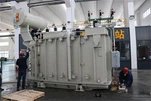
A leak that leaves the factory becomes a warranty claim in another country, so the routine pressure test is not a formality. Standard practice holds a sealed oil-immersed transformer tank at roughly 35 kPa - about 5 psi - above the normal head of oil for 12 to 24 hours. IEC 60076-1 specifies 30 kPa for 24 hours on units above 20 MVA or 72.5 kV, and North American utility specifications frequently call for 7 psi for 24 hours across the tank and radiators together. The methods themselves live in IEEE Std C57.12.90-2026, the standard test code for liquid-immersed transformers, with the general requirements in IEEE Std C57.12.00-2021.
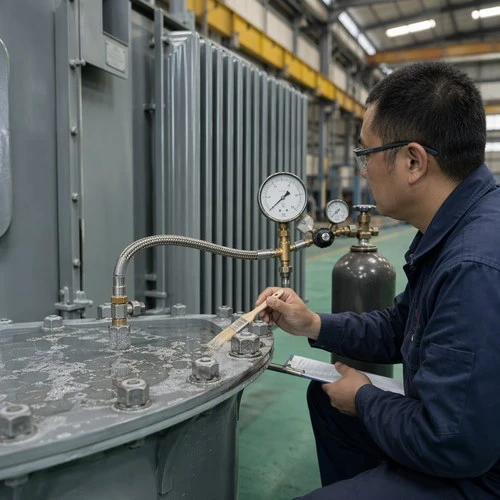
A pressure gauge on its own will not find a weeping gasket. Soap solution brushed along every joint during the hold period is still the fastest detector in a transformer hall, because it shows a leak when the leak starts rather than when enough oil has escaped to move the dial. We repeat the same brush-and-gauge routine after any repair, and the record - pressure held, hold time, unit serial number - travels with the test report.
Seven Sealing Details Most Specifications Leave Out
Read any transformer data sheet and you will find kVA, impedance, temperature rise and losses. You will not find these:
- A gasket callout, not a material name. Ask for the ASTM D2000 line number with hardness and gasket compression set limits.
- Bolt torque with a tightening sequence, plus the re-torque interval after the unit is energised and load-cycled.
- Flange face finish and flatness. A gasket cannot bridge a warped flange. Around 125 µin (3.2 µm) Ra is a reasonable default.
- Hardware material. Stainless or hot-dip galvanized fasteners for coastal, desert and high-humidity sites.
- Valve stem packings. Drain, filter press and pressure-relief stems are their own failure family and their own line item.
- Leak test pressure, duration and acceptance criteria, confirmed in a signed record that names the individual unit, not the order.
- A spare gasket kit and the torque table shipped inside the tank compartment, because the fastest repair on a pad is your own crew replacing a gasket.
Six of those seven items cost nothing to add to a purchase order. The seventh costs a few dollars.
What a Leak Costs Once the Pad Is Poured
A weep on a pad in a rural yard is an afternoon with a wrench and a spill kit. The same weep inside a vault under a city sidewalk is a permit, an excavation and a weekend outage, and from that point the cost is dominated by access rather than by parts. That asymmetry is why transformer oil leaks are worth arguing about at the quotation stage instead of the maintenance stage.
In the United States the containment question is also a regulatory one. Facilities covered by the SPCC rule must provide secondary containment sized to the largest single container, and oil-filled equipment that qualifies may use alternative provisions - but only with documented inspection and integrity testing built into the plan. The EPA guidance on SPCC secondary containment and the rule text in 40 CFR Part 112 are the places to start, not a supplier brochure.
There is a second cost that never reaches an invoice. A tolerated weep slowly lowers the oil level, lets moisture into the headspace, and makes next spring's dissolved gas sample harder to read - because a unit losing oil is also a unit breathing air.
Four Questions to Ask Before You Order
Ask these before you sign, and most of the sealing argument is settled:
- What is the gasket callout, and can you send the compression-set data behind it?
- What pressure did the unit hold, for how long, and will the leak test record carry the serial number?
- Where is the bolt torque table, and does it state a re-torque interval?
- Are cover, flange and valve-stem gaskets available as spares without a special order?
Ryan Electric builds oil-immersed transformer units and cast-resin dry-type units for utility, industrial and data center duty as an Eaton joint venture partner, with UL, CSA, IEEE and DEKRA certification in the portfolio. Every liquid-filled unit leaves our test bay with a pressure and leak test record that names the unit serial number, the pressure held and the hold time - because that document is what a warranty discussion turns on two years later. If you are specifying a replacement or deciding whether the weep on an existing unit justifies an outage, send the photographs and the nameplate through ryan-transformers.com and our engineers will tell you which joint to look at first.
About the Author: This article was written by the engineering team at Ryan Electric, a transformer manufacturer in Jiangsu, China and an Eaton joint venture partner, producing oil-immersed, dry-type and pad-mounted transformers for utility, industrial and data center projects across North America, Southeast Asia, the Middle East and Africa. Factory testing follows IEEE and IEC procedures, with UL, CSA and DEKRA certification available for North American and international projects.