

Three suppliers quote the same 1,000 kVA pad-mounted transformer. The lowest price is USD 18,000 and the highest is USD 21,000. On a utility bid tabulation in the United States, the USD 21,000 unit wins - and it is not a clerical error. The column that decided it was transformer loss capitalization, and it is the only column in the table that keeps costing money for the next twenty-five years.
Why Purchase Price Is the Wrong Number
Loss evaluation is not a new idea. IEEE C57.120-2017 exists precisely to handle it, and the scope is stated plainly: the guide covers the economic loss evaluation of liquid-filled and dry-type distribution and power transformers, and provides formulas by which the costs of energy, power, financing and the loading pattern of the equipment can be converted into monetary values per kilowatt of losses. In other words, the standard tells you how to turn a wait into a dollar figure. You can see the scope on the IEEE C57.120-2017 record.
The regulated efficiency floors make the problem sharper rather than simpler. Under the DOE standard the minimum efficiency of a low-voltage dry-type distribution transformer is set at 35 percent of nameplate load, while liquid-immersed and medium-voltage dry-type units are measured at 50 percent of nameplate load. Both are part-load points. Two units can clear the same floor at that one operating point and still differ by thousands of dollars over a service life, because the floor says nothing about how the losses are split between core and winding. The current text, with the 2016 and 2029 tables, is on the 10 CFR 431.196 page.
No-Load Loss and Load Loss Behave Completely Differently
The no-load loss - core loss - is essentially constant from the moment the unit is energised, whether it is carrying 5 percent or 100 percent of rating. It accrues for 8,760 hours a year. A 1,000 kVA unit with a no-load loss of 1.1 kW burns 9,636 kWh a year doing nothing but staying alive; at USD 0.10 per kWh that is about USD 964 a year, and roughly USD 24,000 over twenty-five years before any discounting.
The load loss - copper loss - behaves nothing like that. It varies with the square of the load and accrues only while the unit is loaded, which is why it is weighted by a loss load factor rather than by calendar hours. It is also temperature-dependent, so a load loss figure means nothing until you know the reference temperature it was corrected to. That single omission is the most common reason two bids are compared incorrectly.
In our works the routine test report gives measured no-load loss and measured load loss as separate figures, taken per IEC 60076-1, with the reference temperature stated. That separation is the whole point. A total-loss number alone cannot be evaluated, because the two components carry completely different weights in the capitalization formula.
The Transformer Loss Capitalization Formula, Step by Step
Four steps take you from a test report to a comparable number.
Step 1 - value the no-load loss. A (USD per watt of no-load loss) = (8,760 h x energy price per kWh / 1,000) x present value factor.
Step 2 - derive the loss load factor. LLF = 0.3 x LF + 0.7 x LF squared, where LF is the load factor of the circuit.
Step 3 - value the load loss. B (USD per watt of load loss) = A x LLF.
Step 4 - capitalise both. Capitalised loss cost = A x P0 + B x Pk, where P0 is measured no-load loss in watts and Pk is measured load loss in watts.
Worked example, with every assumption stated so you can re-run it: 1,000 kVA three-phase liquid-immersed unit; 25-year study life; 7 percent discount rate, which gives a present value factor of 11.65; energy at USD 0.10 per kWh; circuit load factor 0.45, which gives LLF = 0.277. Step 1 produces A = USD 10.21 per watt; Step 3 produces B = USD 2.83 per watt.
| Bid | Purchase price | No-load loss P0 | Load loss Pk | Capitalised loss cost |
| A (cheapest) | USD 18,000 | 1,400 W | 8,000 W | USD 36,934 |
| B (efficient) | USD 21,000 | 1,100 W | 7,100 W | USD 31,324 |
Bid A costs USD 3,000 less at the order desk and USD 5,610 more in capitalised losses. Net position: Bid B is ahead by USD 2,610 before a single maintenance hour is counted. That is the entire argument for loss evaluation in one line, and it is why an evaluation clause in the purchase specification is worth more than another round of price negotiation.
Loss Load Factor: Where Most Estimates Go Wrong
The loss load factor is always lower than the load factor, and it falls away faster as the load factor drops. At LF 0.45 the LLF is 0.277 - so load loss is weighted at roughly 28 percent of the no-load weight, not 45 percent. Two mistakes follow from missing that.
The first is using the load factor in place of the loss load factor, which overstates the value of load loss and can make a high-efficiency bid look better than it is. The second is worse: treating load loss as if it accrued 8,760 hours a year, which overstates B several times over and can push a buyer into paying for loss reduction that will never be recovered.
There is a third trap with no arithmetic in it at all. Load loss is quoted at a reference temperature, and IEEE and IEC practice do not necessarily correct to the same one. When you put two bids side by side, put the reference temperature next to the Pk figure, or the comparison is fiction.
The DOE Floor Is Not the Optimum, and It Moves in 2029
It is tempting to treat the efficiency standard as the target. It is a floor, and it is measured at part load. Here are the actual numbers from the federal text for three-phase units, showing the level now in force and the level that applies to units manufactured on or after 23 April 2029.
| Type / basis | Rating | Level to 23 Apr 2029 | Level from 23 Apr 2029 | Basis |
| LV dry-type | 75 kVA | 98.60% | 98.88% | 35% load |
| LV dry-type | 500 kVA | 99.14% | 99.31% | 35% load |
| LV dry-type | 1,000 kVA | 99.28% | 99.42% | 35% load |
| Liquid-immersed | 500 kVA | 99.35% | 99.38% | 50% load |
| Liquid-immersed | 1,000 kVA | 99.43% | 99.46% | 50% load |
| Liquid-immersed | 2,500 kVA | 99.53% | 99.55% | 50% load |
Compliance with the amended standards is required for units manufactured on and after that date, as set out in the DOE final rule published at 89 FR 29834. The practical reading: a distribution transformer has a service life measured in decades, so a unit bought this year at the 2029 loss profile is still earning back the difference long after the floor has moved. Buying above the floor is not goodwill - it is buying a better asset three years early. Transformer loss capitalization is how you put that difference on paper instead of leaving it in an argument.
What to Put in the RFQ So the Comparison Is Real
Six lines in the specification make every bid comparable on the same basis:
1. Measured losses, not guaranteed losses. Require the routine test report values for P0 and Pk from the unit that is actually being supplied, with the reference temperature stated.
2. State A and B in the RFQ. If you do not publish your capitalization factors, every bidder will compute a different total - and the lowest bidder will compute the one that favours them.
3. State the load factor, study life and discount rate. These three inputs drive the result more than any other assumption, and they are yours to set, not the supplier's.
4. Name the test method. Loss measurement to IEC 60076-1 or IEEE C57.12.90, stated explicitly, so the figures are produced on a known basis.
5. Apply the loss evaluation contractually. If capitalized losses are a bid adjustment in the award decision, write that into the commercial terms. An evaluation that lives only in a spreadsheet disappears at award.
6. Ask for the split, always. A single total-loss figure cannot be capitalized correctly. Demand P0 and Pk separately.
How Ryan Electric Handles Loss Data - and How to Start
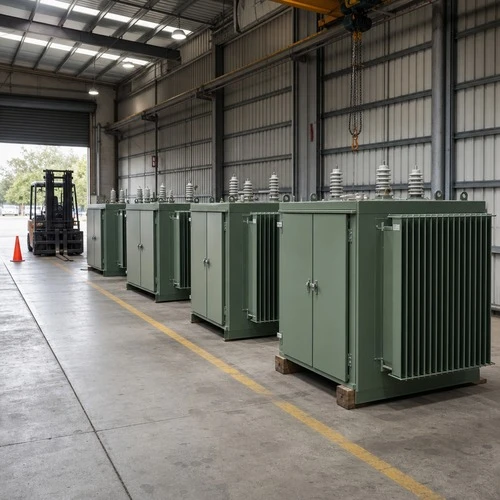
Our works in Jiangsu covers 120,000 square metres with 37 patents and more than 180 sets of production and test equipment, and the certification portfolio runs across UL, CSA, IEEE, DEKRA, CNAS and CE. We have been an Eaton joint venture partner since 2023. As a pad mounted transformer manufacturer supplying North American utilities and EPC contractors, one habit matters more than the rest: the no-load loss and load loss figures in our routine test report are measured values split by component, with the reference temperature printed alongside, so your evaluation formula can be run from the report itself rather than from a marketing datasheet.
The same logic applies from a 75 kVA distribution unit to a large substation transformer. If you are building a bid evaluation, or specifying a pad mounted transformer fleet for a North American utility, send us five things: the kVA and voltage class, the circuit load factor, the study life and discount rate you use, your A and B factors, and the destination market. We will come back with the loss data in exactly the form your evaluation needs, so that you can run transformer loss capitalization yourself, with the test report to support it. Reach the team through ryan-transformers.com.
About the Author: This article was written by the engineering team at Ryan Electric, an Eaton joint venture partner and UL/CSA-certified transformer manufacturer in Jiangsu, China, serving utility, industrial and data centre clients across North America, the Middle East, Africa and Southeast Asia.