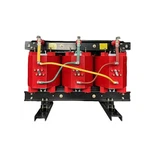


Last month, a buyer from a Gulf utility sent us a nameplate photo and asked one question: "This unit is rated 25 MVA ONAN. Can we run it at 30 MVA if we bolt on fans?" The honest answer took two paragraphs, not one sentence. Transformer cooling methods determine how much of the nameplate you can actually use, and getting the answer wrong ends in an overheated unit, a voided warranty, or a substation outage on a 50°C afternoon.
Transformer Cooling Methods: Why Cooling Sets the Real Capacity
Every transformer generates heat from two sources: no-load loss in the core and load loss (I²R plus stray losses) in the windings. That heat has to leave the tank or the enclosure, and the balance between heat generation and heat removal fixes the winding temperature - which is what the standards actually regulate. Push the load up and the winding heats; let the winding get too hot and the insulation ages far faster than the design assumed. The loading guides (IEEE C57.91 for oil-immersed units, IEC 60076-7 for general practice) are built on one simple observation: above a 98°C hot-spot reference, the relative aging rate of the insulation roughly doubles for every 6 K of additional temperature.
In our factory, we demonstrate this on every unit that leaves the heat-run bay. A temperature rise test per IEEE C57.12.90 runs the transformer at rated load for hours, then we measure winding resistance cold and hot to compute the average winding rise - a measured number, not an estimate. That test is where a cooling design proves itself or gets sent back to the drawing board.
Reading the Cooling Code: ONAN, ONAF, OFAF and Beyond
The IEC 60076-2 letter code for liquid-immersed transformers reads like a chemical formula, and it is just as precise. The first letter names the coolant - O for mineral oil, K for ester fluid, L for an unidentified synthetic liquid. The second letter says how the coolant circulates: N for natural convection, F for forced flow with a pump, D for directed flow that pushes oil through the windings. The third letter names the external medium, almost always A for air or W for water. The fourth letter repeats the circulation logic for that external medium.
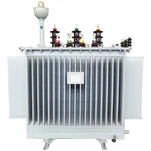
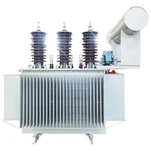
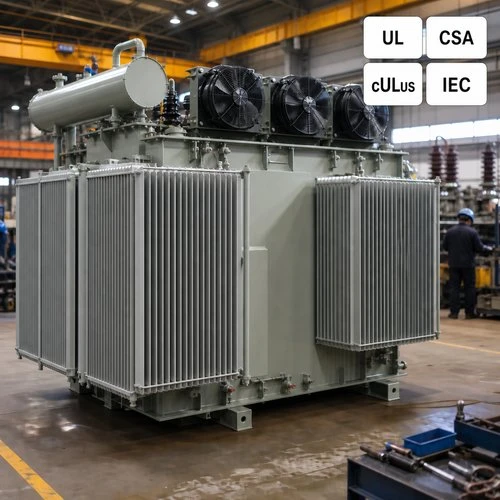
So ONAN means oil natural, air natural - the unit cools itself by convection and radiator airflow, with zero moving parts. ONAF adds fans: oil still circulates naturally, but forced air blows across the radiators. OFAF adds an oil pump on top of the fans, and ODAF directs that pumped oil straight through the winding ducts. Each step up the ladder moves more heat, and each step adds moving parts that need maintenance.
Here is the part most buyers miss: a single nameplate often carries two or even three ratings - for example 25 MVA ONAN / 33.3 MVA ONAF. The fans switch on automatically when the winding temperature crosses the set point, and the transformer is thermally and contractually a different machine at each rating.
What the Ratings Mean in Practice
The classic rule of thumb: forced-air cooling adds roughly one-third of capacity over the self-cooled rating. A 10 MVA ONAN unit is commonly rated 13.3 MVA ONAF; a two-stage arrangement (ONAN/ONAF/ONAF) might step 100% → 115% → 133%. The exact percentages come from the heat-run test results, which is why the test report matters more than the brochure.
Ambient temperature is the second half of the story. Nameplate ratings assume a maximum 40°C ambient. In the Gulf, on a 50°C day, that same 25/33.3 MVA unit must be derated or its hot spot will run past the 80°C rise limit (IEEE) or the 78 K limit (IEC). Back to our Gulf buyer: our engineers ran the load-capability curves per IEEE C57.91 and told him the truth - with fans and a 50°C ambient, the safe continuous figure for his duty cycle was 28.5 MVA, and the extra headroom was available only as a monitored, time-limited peak. He ordered the fans anyway, but he ordered the correct protection settings with them. That conversation is why we publish loading curves, not just nameplates.
The cooling class is also the cheapest upgrade in transformer buying, and it is the transformer cooling methods question most RFQs skip. Asking for an ONAF stage at the specification stage costs a few thousand dollars; retrofitting fans and control wiring after commissioning costs ten times that and takes the unit out of service.
Temperature Rise Limits: The Numbers Behind the Nameplate
For oil-immersed units, IEEE C57.12.00 caps the average winding temperature rise at 65°C, the top-oil rise at 65°C, and the winding hot-spot rise at 80°C above ambient. The IEC 60076-2 limits are close but not identical - 60 K for top oil, 65 K for average winding, and 78 K for hot spot. That difference is small, but it is exactly the kind of detail that surfaces when a unit built to one standard is submitted for certification under the other, so it is worth knowing which one your project references.
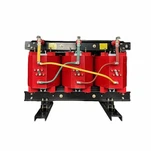
Dry-type units follow a different table. Under IEC 60076-11, the average winding temperature rise limits are 80 K for Class B insulation, 100 K for Class F, and 150 K for Class H, with the hot-spot allowance on top. A cast resin transformer rated for a 100 K rise at full load has a very different thermal budget from an H-class unit, and the choice shows up in the enclosure size, the cooling fans, and the price.

None of this is paperwork for its own sake. The temperature-rise test report is the document that proves your transformer can carry its nameplate in the ambient your site actually sees. When we quote a unit, the measured rise values from the factory heat-run - top oil, average winding, hot spot - go into the routine test report, because our customers' engineers ask for them.
Ryan Electric's Approach to Cooling
Our factory in Jiangsu builds oil-immersed units from distribution size up to 200 MVA and dry-type units for data centers and industrial plants, so cooling design is not a catalog checkbox - it is matched to the site. As an Eaton joint venture partner with UL, CSA, IEEE, and DEKRA certification coverage, we have to document every thermal assumption anyway, and that works in the buyer's favor: loading curves, heat-run data, and cooling class specifications ship with the unit.
The practical advice from our engineers is short. Tell your supplier the worst-case ambient, not the annual average. Ask which cooling class the nameplate rating assumes, and whether the temperature-rise test report shows measured values or guaranteed ones. If a quote cannot answer those two questions in writing, that is your answer.
Ready to Spec Your Next Transformer?
Next time you size a unit, ask about transformer cooling methods before you compare prices, because the cooling class is what turns a nameplate into a usable asset. Send us your load profile, worst-case ambient, and certification target through ryan-transformers.com and we will come back with the cooling class recommendation, loading curves, and a realistic schedule.
About the Author: This article was written by the engineering team at Ryan Electric, an Eaton joint venture partner and UL/CSA-certified transformer manufacturer in Jiangsu, China, serving utility, data center, and industrial clients across North America, the Middle East, Southeast Asia, and Africa.