

Solar Farm Transformer Selection in 2026: Ratings, Standards, and RFQ Essentials
By the time a utility-scale solar plant reaches grid connection, the transformer is usually the last piece of equipment standing between the inverter and the substation. In 2026, with global PV installation targets still climbing and EPC schedules tightening, that final step is where many projects lose weeks. The fix is rarely technical heroics - it is picking the right solar farm transformer type before procurement starts.
We have shipped transformers to solar projects across North America, the Middle East, and Southeast Asia, and the same three questions come up every time: dry type or oil immersed? Pad mounted or skid-mounted? And which ratings actually matter on the RFQ? This guide answers those questions with the numbers our engineers use internally.
Why a Solar Farm Transformer Is Not a Standard Distribution Unit
The first mistake buyers make is treating a solar plant like a small commercial building. It is not. A solar farm transformer runs on a generation profile: full load from late morning to late afternoon, then near zero at night. That daily cycle drives thermal and mechanical stress that a normal building load curve never creates, which is why nameplate life ratings assume a steady duty cycle - not a solar one.
The environment is different too. Ground-mounted arrays sit in open fields: desert sand in the Gulf, salt-laden coastal air in Southeast Asia, sub-zero winter nights in northern latitudes. A unit engineered for a climate-controlled utility room will not hold up there, and most failures we see on site trace back to environmental assumptions made at the specification stage.
Voltage levels separate the two worlds as well. Inverters output at 480 V or 600 V AC, and the transformer for solar farm application steps that up to 34.5 kV (standard across the US), 33 kV (much of the Middle East and Asia), or 11 kV/22 kV for smaller feeders. Add a battery energy storage system (BESS) to the site, and power flow becomes bidirectional - the transformer must absorb charging load at night as well as export during the day. Design rules in IEEE Std C57.12.00 and DOE efficiency regulations both apply, and both keep tightening.
The Three Main Transformer Options in 2026
Three transformer families cover the vast majority of PV projects. Each has a clear zone where it wins.
Dry Type Transformers
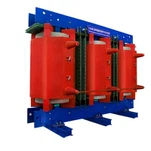
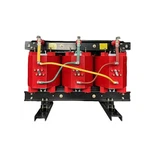
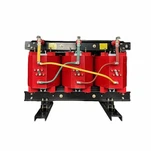
Cast resin and VPI dry types suit compact or indoor installations - rooftop C&I projects, inverter rooms, and hybrid sites where fire codes restrict oil. Typical range: 0.5–5 MVA at 480 V stepping to 13.8 or 34.5 kV. Maintenance is minimal and no oil containment is needed, but first cost per kVA runs higher, and large outdoor ratings get expensive quickly.
Oil Immersed Transformers
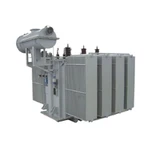
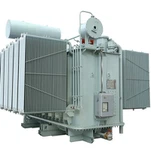
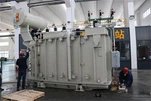
The workhorse for ground-mounted plants. Mineral oil - or ester oil on environmentally sensitive sites - handles cooling efficiently, which matters when a unit runs at full load for six straight hours under midday sun. Ratings typically start at 5 MVA and reach 40 MVA+ per unit, with conservator or sealed-tank designs. Loss data and life expectancy are the most thoroughly documented of the three options.
Pad Mounted Transformers
For North American projects, pad mounted transformer units are the default: dead-front design, tamper-resistant enclosure, UL or CSA listing required for grid interconnection. Typical sizing is 2–5 MVA per unit, with larger sites using several units in parallel. Enclosure integrity follows IEEE Std C57.12.28, which our factory verifies before every shipment to the US or Canada.
The table below summarizes how the three solar farm transformer options compare in 2026.
|
Parameter |
Dry Type |
Oil Immersed |
Pad Mounted |
|
Typical rating |
0.5–5 MVA |
5–40 MVA |
2–5 MVA per unit |
|
Primary use |
Rooftop / indoor / hybrid |
Utility ground mount |
North American distribution |
|
Cooling |
Air (natural / forced) |
Oil (ONAN / ONAF) |
Oil, enclosed |
|
Certification focus |
IEC / UL |
IEC / IEEE |
UL / CSA |
|
Best for |
Fire-sensitive sites |
Large plants, hot climates |
Grid-tied US/Canada projects |
Matching Transformer Type to Project Scale
Scale decides more than any other factor.
Rooftop and C&I distributed systems (under 2 MW). These usually interconnect at low voltage or on small MV feeders. A compact dry type, or a small oil unit on a skid, keeps civil works simple and commissioning fast.
Ground-mounted utility plants (10–100 MW). Oil immersed units dominate, arranged in 2–5 MVA groups, with an MV collector line feeding one larger step-up transformer at the point of interconnection. Many EPCs standardize on pad mounted units for the distribution segments and a single large unit at the substation.
Hybrid PV + BESS sites. Bidirectional flow changes the specification. Our engineers specify higher insulation margins and coordinate impedance (%Z) between transformer and PCS to keep voltage regulation stable in both directions. This is where a custom MV transformer for PV plant duty earns its keep - catalog units rarely match the exact %Z the PCS manufacturer asks for.
One habit we see in the field: teams order the inverter first, then spec the transformer afterward, and discover the voltage and impedance don't line up. Send the inverter datasheet and your grid code to the transformer supplier together with the RFQ. It saves a change order and roughly two weeks of schedule.
What to Put on the RFQ
Five specifications carry most of the risk. Get these right and the rest follows.
Temperature rise: 55 K or 65 K over ambient, stated explicitly. Apply altitude derating above 1,000 m per IEC 60076.
Impedance: typically 4–6% for PV duty; confirm with the PCS manufacturer to avoid harmonic resonance issues.
Corrosion protection: coastal and desert sites need C5-grade coating and 1,000-hour salt spray verification. We run this on every export unit headed to the Gulf.
No-load loss: a solar transformer idles every night, so lower no-load loss pays back year after year - and it is exactly what the DOE's amended distribution transformer standards target.
Certifications: UL listed for the US, CSA certified for Canada, IEC 60076 for most other markets. Check the nameplate language your utility's interconnection agreement requires.
A solar farm transformer specified this way - with environmental class, impedance, and certification locked in writing - is a procurement package your consultant can approve without reopening engineering. That is the outcome we aim for on every PV project we quote.
Why Ryan Electric for Solar Projects
Ryan Electric has built transformers for generation and industrial customers since 2007, and our solar portfolio spans small C&I dry types up to 40 MVA oil immersed units. As an Eaton joint-venture partner since 2023, we build to the same design discipline the major utilities expect, with UL, CSA, and IEC 60076 certification coverage across the product lines.
On a recent Middle East project, the client needed pad mounted units with C5 corrosion protection and a 33 kV winding - a standard catalog unit would not have survived that site. We engineered the coating system, ran the salt spray verification, and shipped within the agreed window. That request is routine for us, not a special case.
Every unit leaves our factory with a complete test report: turns ratio, no-load loss, load loss, impedance, and dielectric tests. The paperwork matches the hardware, which is exactly what your consultant and your utility inspector will check.
Have a solar project in the US, Middle East, or Southeast Asia? Send us your inverter data and grid code - get a free technical quote within 48 hours.