

Best Transformer for Solar Farm Application: Types and Selection Guide in 2026
A 120 MW solar farm in Vietnam was two weeks from its grid-connection date when the utility's review team flagged the step-up transformers: impedance values did not match the local grid code, and the no-load loss figures missed the efficiency band the PPA required. That single discrepancy cost the developer a month of re-engineering and triggered a penalty clause. We see this pattern repeat across Southeast Asia and the Middle East - the panels are the easy part; the transformer for solar farm application is where projects actually get won or lost.
In this guide, we break down the three transformer types that dominate utility-scale solar, the specifications that matter at 34.5 kV interconnection, and the certification questions you should settle before signing a PO.
Why Solar Farms Need a Dedicated Step-Up Transformer
Solar modules produce DC; inverters convert it to AC, typically at 480 V to 800 V. That voltage cannot travel far - at 600 V, a 3 MW feeder would need cable cross-sections no project budget survives. So every utility-scale plant collects AC output at the inverter station and steps it up to a medium-voltage level - 34.5 kV in North America, 33 kV across much of Asia - through a solar farm step-up transformer before the power reaches the collection substation.
That choice drives three things: system losses, interconnection cost, and project timeline. A transformer running 0.3% below target efficiency on a 100 MW plant at 1,800 full-load hours per year means roughly 540 MWh of lost revenue annually - numbers that PPA financiers now check line by line.
Here's the part most buyers miss: the transformer for solar farm application is usually the longest-lead item in the entire electrical BOM. Inverters ship in weeks; a custom medium-voltage transformer runs 16 to 24 weeks, longer during the current global build-out. That lead time alone makes transformer selection an early-stage engineering decision, not a procurement afterthought.
Three Transformer Types That Dominate Utility-Scale Solar
Most utility-scale projects come down to three configurations, and the right answer depends on plant size, land cost, and maintenance philosophy. At the high-voltage end, a solar substation transformer lifts the 34.5 kV collector voltage to the 110 kV or 230 kV transmission level.
Pad Mounted Transformer for Solar (Ground-Mounted, Dead-Front)
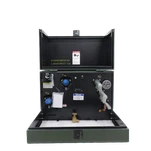
Compact, tamper-resistant, and serviceable from the front. We supply pad mounted transformer for solar units with dead-front design - no exposed live parts - which is exactly what utilities in North America expect for ground-level installations. Standard range: 500 kVA to 5,000 kVA at 34.5 kV or lower primary voltage. Best fit: medium-size plants, rooftop or ground-mount arrays where space is tight and security matters.
Oil-Immersed Step-Up Transformer (Pad or Skid Mounted)
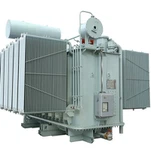
The workhorse of utility-scale solar. Oil-immersed units handle the largest capacities at the lowest first cost per kVA, and their cooling - ONAN to ONAF - scales with duty. For a 100 MW plant we typically engineer four 30 MVA units or eight 15 MVA units at the collection substation, with conservator tanks and nitrogen-sealed designs specified for desert sites.
Cast Resin Dry-Type Transformer (Inverter Station Duty)
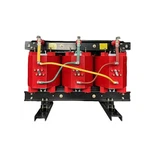
Where fire codes or indoor layouts rule out oil - inverter stations inside buildings, rooftop retrofits - a cast resin dry-type transformer answers. Cast resin windings carry a higher price premium but offer low partial discharge, no oil containment requirement, and an indoor-friendly footprint.
|
Type |
Typical Range |
Cooling |
Best Fit |
Maintenance |
|
Pad mounted (dead-front) |
500 kVA – 5,000 kVA |
ONAN |
Medium plants, tight sites |
Low |
|
Oil-immersed step-up |
5 MVA – 60 MVA |
ONAN / ONAF |
Utility-scale substations |
Moderate (oil sampling) |
|
Cast resin dry-type |
500 kVA – 12,500 kVA |
AN / AF |
Indoor inverter stations |
Very low |
Key Specifications That Decide the Choice
Four numbers on the datasheet tell you whether a unit will actually perform on your site.
• **Voltage and vector group.** Match the primary to the collector voltage and the secondary to the inverter output. Dyn11 is the most common vector group for solar step-up transformers because it handles unbalanced loading and provides the neutral for grounding.
• **Losses and efficiency.** US projects must meet the DOE 2026 efficiency levels set by the U.S. Department of Energy; our oil-immersed distribution transformers are engineered to beat the DOE 2026 minimum by design margin. Ask for measured no-load and load loss figures from routine tests, not catalogue averages.
• **Temperature rise and derating.** Standard oil-immersed rise is 65°C; above 1,000 m altitude or 40°C ambient, expect derating - or specify forced cooling (ONAF) to hold nameplate output.
• **Impedance.** The utility's short-circuit level sets the required %Z, typically 5.5% to 7% at the solar substation transformer. Getting this wrong is what triggers the interconnection rejection we opened with.
Need these specifications mapped to your plant size and grid code? Our engineers answer within one business day - get a free technical quote → Contact Ryan Electric's Engineering Team
Certification and Compliance: UL, CSA and IEC
Certification is where imported solar transformers live or die at customs and interconnection review. For North American projects, enclosure and pad-mounted units follow the test procedures published by the IEEE Standards Association (IEEE C57.12.90), and a UL listed transformer for solar carries the mark - verified under UL 1561 - that US utilities and authorities having jurisdiction actually look for on the nameplate. Canadian projects additionally reference CSA C22.2 standards; a cULus listing covers both markets from one production line.
For Southeast Asia and the Middle East, the reference shifts to IEC 60076, and grid codes vary by country - so we confirm the local utility's short-circuit level, earthing philosophy, and protection coordination before freezing the design. Test reports are issued per batch: turns ratio, polarity, no-load loss, load loss, dielectric, and temperature rise.
Ryan Electric: One Factory, All Three Configurations
Most manufacturers push the one product line they happen to build. We build all three - pad mounted transformer for solar, oil-immersed step-up, and cast resin dry-type - on the same factory floor, which means one engineering team, one certification file, and one warranty conversation for your whole plant. As an Eaton joint venture partner since 2023, our engineering team works inside a component supply chain that carries its own certifications, which shortens the certification loop for custom designs.
A recent utility-scale project in the Philippines took delivery of sixteen 15 MVA oil-immersed solar farm step-up transformer units for a 240 MW plant. The batch passed routine tests at 100% nameplate rating and arrived in the agreed shipping window - whether a UL listed transformer for solar for a Texas plant or an IEC 60076 unit for a Malaysian one, the test floor runs the same sequence before crating.
How to Choose the Right Transformer for Solar Farm Application
The transformer for solar farm application decision is really a risk decision: lead time, losses, and certification determine whether your plant connects on schedule and performs to the PPA. Get those three right, and the rest of the electrical package tends to follow.
Have a solar project in Texas, Vietnam, or Riyadh? Send us your site data - plant capacity, collector voltage, grid code - and get a free technical quote → Contact Ryan Electric's Engineering Team