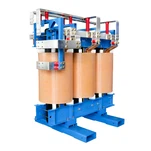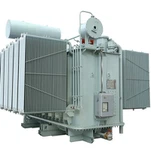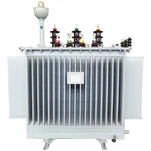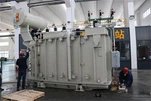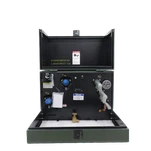


A contractor in Texas sent us photographs of two cast resin units he had installed himself last spring. Six months later, both had tripped on winding temperature during a 41 °C afternoon. The transformers were fine. The enclosure was the problem.
The dry type transformer enclosure is usually the last item anyone argues about in an RFQ, and it is one of the few decisions that can quietly cut the capacity of the unit inside it. Sheet metal does not transform anything, but it decides what the transformer breathes - dust, salt, rain, or its own recirculated hot air - and that decides how long it lasts.
What follows is what we look at when a buyer sends a site description: the NEMA Type definitions and where they stop, the point at which IP ratings stop being a substitute for a Type number, what NEC Article 450 requires indoors, and how site conditions change the answer.
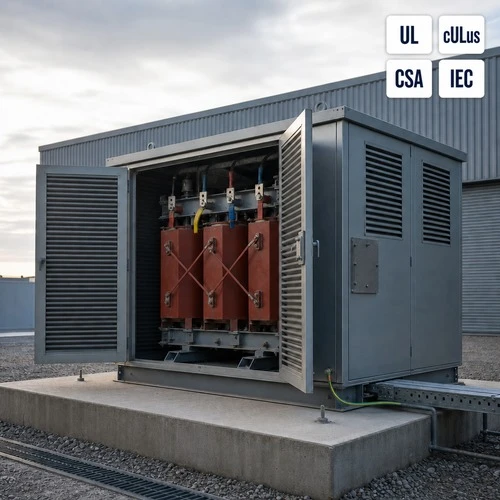
Why the Dry Type Transformer Enclosure Decision Comes Before the Order
A dry type transformer is rated on usual service conditions that the enclosure either protects or breaks. ANSI/IEEE C57.12.01 anchors the rating basis at a maximum ambient of 40 °C with a 30 °C daily average, and at altitudes up to 1,000 m. Every degree above that - and every meter of altitude - eats into the kVA standing on the nameplate. The enclosure decides which side of 40 °C the unit actually sees.
The second reason to settle it before the order is dimensional. Ventilation area, busway entry positions and cable gland plates are fixed when enclosure drawings are approved, and winding geometry moves with them. In our factory, an enclosure change after drawing approval is a re-engineering job, not a repaint - and on cast resin units running a 16 to 20 week lead time, re-engineering is the expensive part.
What Each NEMA Enclosure Type Actually Protects
Selecting a dry type transformer enclosure starts with the location, and NEMA publishes the definitions. The short version for transformer work:
| Enclosure type | Location | Protects against | Where we see it specified |
|---|---|---|---|
| Type 1 | Indoor only | Falling dirt; access to hazardous parts | Electrical rooms, dry indoor halls |
| Type 2 | Indoor | Falling dirt; dripping and light splashing water | Rooms with cleaning or wash-down nearby |
| Type 3R | Indoor or outdoor | Rain, sleet, snow; undamaged by external ice. Not windblown dust | Outdoor pads in clean, low-dust yards |
| Type 3 | Indoor or outdoor | Rain, sleet, snow; windblown dust | Outdoor industrial and process yards |
| Type 4 / 4X | Indoor or outdoor | Hose-directed water; 4X adds corrosion protection | Wash-down bays, coastal sites |
| Type 12 | Indoor | Circulating dust, lint, fibers; oil and coolant seepage | Machine shops, process plants |
The distinction that costs money sits between Type 3R and Type 3. Both shed rain and sleet. Only Type 3 is also rated against windblown dust. On a cement, grain or mining site, a NEMA 3R enclosure with unfiltered louvers works as a dust pump, and the winding insulation collects the result. If there is visible dust in the air, move up to Type 3 with filtered ventilation or commit to a filter service interval that people will actually follow.
There is also a voltage boundary worth knowing. This enclosure system is defined for equipment rated up to 1,000 V. A medium-voltage dry type unit - 601 V and above in the highest voltage winding - is covered by ANSI/IEEE C57.12.01 for construction requirements, and its enclosure is specified on the manufacturer's drawings rather than chosen from a table.
IP Ratings Are Not NEMA Equivalents
Specifications often read "NEMA 3R or equivalent, IP23 acceptable". NEMA has stated plainly that this does not work. In its published enclosure type document, the association notes that IEC 60529 designations cannot be exactly equated with NEMA Type numbers, because the tests behind them are not the same: a NEMA Type carries corrosion, gasket aging, dust and external icing tests that IEC 60529 does not require, and IEC 60529 permits a degree of water entry as long as it does not reach live parts or deposit on insulation. The definitions are published in the NEMA enclosure types document.
The consequence shows up at bid comparison. Where a specification accepts an "IP equivalent", a cheaper ventilated enclosure can satisfy the wording and still leave the transformer exposed to exactly what the original Type number was chosen to exclude. NEMA's own conversion table is a useful reality check: it does not list a NEMA 3R enclosure among the types that qualify for an IP45 application, and the half of the requirement it fails is the dust half.
If a project genuinely needs an ingress rating, write a specific Type number with a no-substitution clause and ask every bidder for test reports. The IEC explains what each numeral proves on its IP ratings page.
Indoor vs Outdoor Transformer Installation: Clearances, Ventilation and NEC 450
Two NEC requirements decide most indoor layouts. For dry type transformers installed indoors and rated 112.5 kVA or less, NEC 450.21(A) requires at least 12 inches of separation from combustible material. Above 112.5 kVA, 450.21(B) puts the unit in a transformer room of fire-resistant construction with a one-hour rating unless a listed exception applies. That single threshold changes the room, the wall assembly and the construction sequence. The code text and revision history are on the NFPA 70 page.
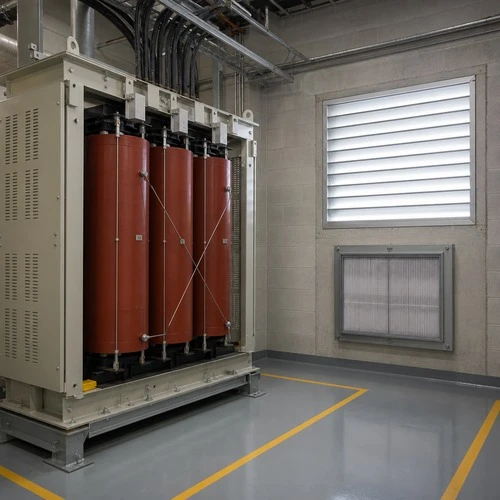
The second requirement is qualitative, and this is where indoor vs outdoor transformer installation planning usually fails. NEC 450.9 requires ventilation adequate to dissipate the heat the windings produce under load. It gives you no louver size. The airflow path has to be designed - a low inlet and a high outlet, both kept clear - because a dry type transformer enclosure cannot rescue a room whose only opening is the door. IEEE C57.94, the recommended practice for installation and application of dry-type transformers, covers the clearances and ventilation checks; it is the document we send contractors who ask how much louver area they need. See the IEEE C57.94 standard page.
When a buyer sends photographs before the order, two details go to the top of our list. First, where the outlet sits relative to the coils: if hot air leaves above nothing and returns along the ceiling, the unit sits in the top of the room rather than in its airflow. Second, whether the floor or pad drains. More dry type transformers are derated by standing water and blocked filters than by genuine overload.
Site Conditions That Change the Answer
Four site conditions move the dry type transformer enclosure decision more than any catalog feature.
- Maximum ambient above 40 °C. The rating basis assumes 40 °C, so a plant that reaches 46 °C in July sits outside it. Ask for a derating table built on your site maximum rather than the annual average, and get the temperature-rise test data for the design you are buying.
- Altitude above 1,000 m. Thinner air cools less effectively and the standard rating basis stops at 1,000 m. Derating, and in some designs clearance and creepage, need to be rechecked before the order is placed.
- Salt and persistent humidity. Coastal sites need protection beyond Type 3R. Hinges, gasket seats and nameplate mounting are the first items to fail in a marine atmosphere, and a documented salt-spray result is worth more than an enclosure description.
- Dust, lint and fibers. A NEMA 3R unit with open louvers in a dusty yard ingests what it stands in. Type 12 for indoor rooms with airborne dust, or Type 3 outdoors with filters and a written service interval.
None of this is exotic work. Our export team keeps a one-page site questionnaire - maximum ambient, altitude, dust exposure, distance to the coast, drainage, and the room's ventilation arrangement - and the orders that answer it in writing before the drawing stage almost never come back with an enclosure complaint. The ones that skip it tend to reappear in June.
For a fast sanity check on indoor vs outdoor transformer installation, the question is not which enclosure looks better on paper. It is whether the location will still be dry, clean and below 40 °C in the fifth year of service.
The Ryan Electric Approach
Ryan Electric has been building transformers since 2007 at a 120,000 m² manufacturing base in Jiangsu, with more than 180 sets of production and test equipment and 37 registered patents. Since 2023 we have been an official joint venture partner of Eaton. We build cast resin and VPI dry type units and oil-immersed transformers, and we ship to North America, Southeast Asia and the Middle East under UL, CSA, IEEE and DEKRA certification.
Enclosure requirements reach us at the drawing stage, which is where they belong. That is also the point where a standard unit turns into a custom three phase transformer: louver area, filter frames, gland plates and busway entry geometry are designed against the customer's site conditions instead of being adjusted after the steel is cut. As a UL listed transformer supplier to North American EPCs and data center teams, we treat the enclosure drawing as part of the electrical design rather than a shipping accessory.
The documentation package that goes out with these orders covers four items: outline and enclosure drawings, the ventilation assumptions behind them, routine and temperature-rise test data, and the certification files for the destination market. If you are comparing two quotations, ask both suppliers for all four. The gap usually tells you which enclosure you are actually buying.
Ready to Specify the Right Enclosure?
If you are specifying a dry type unit for an outdoor pad, a dusty yard, a coastal site or an indoor electrical room, send the site conditions with your rating - maximum ambient, altitude, dust and salt exposure, and how the room is ventilated. Our application engineers will size the dry type transformer enclosure and the kVA together, so the nameplate you order is the nameplate you can use. Start the conversation through ryan-transformers.com and you will get calculations and a schedule rather than a brochure.
About the Author: This article was written by the application engineering team at Ryan Electric, an Eaton joint venture partner and UL/CSA-certified transformer manufacturer in Jiangsu, China, supplying dry type and oil-immersed transformers to utility, data center and industrial projects across North America, Southeast Asia and the Middle East.