


Cast Resin vs. VPI Dry Type Transformers - A Data Center Engineer's Guide (2026)
Here's a call we get at least twice a month: an electrical engineer at a colocation data center just received a spec sheet that says "dry-type transformer, indoor installation, 10 MVA, 34.5 kV primary." The spec doesn't say whether it should be cast resin or VPI. It just says "dry-type."
That's where the headache starts.
Two very different technologies. Two very different price points. And a project manager asking for the PO by Friday.
This guide breaks down the cast resin vs vpi transformer decision the way we walk through it with customers on our factory floor - no marketing fluff, just the engineering realities that matter when you're powering server racks, not writing a textbook.
What Is a Cast Resin Transformer?
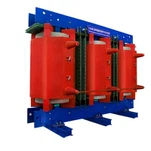
A cast resin transformer uses vacuum-cast epoxy resin to fully encapsulate the high-voltage windings. The process happens under high vacuum - typically below 1 mbar - which eliminates air bubbles from the resin. The result is a solid, glass-smooth block of insulation with the copper or aluminum conductors permanently sealed inside.
The key numbers: insulation class F (155°C temperature rise) or H (180°C), with partial discharge levels below 10 pC at 1.5 times rated voltage. That last number matters more than most engineers realize - low partial discharge means the insulation isn't degrading from microscopic electrical arcs, which directly translates to 30+ years of service life in a data center that runs 24/7/365.
Cast resin units dominate the European market and have been gaining ground in North America, especially for indoor dry type transformer data center applications where humidity control is a concern. The smooth epoxy surface doesn't absorb moisture - a real advantage in tropical climates like Singapore or Miami.
[Image: Close-up of a cast resin transformer winding showing the smooth, glass-like epoxy encapsulation with partial discharge testing probes connected to the terminals.]
What Is a VPI Transformer?
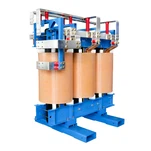
VPI stands for Vacuum Pressure Impregnation. Instead of casting a thick epoxy block, the wound coils go into a vacuum chamber, then get flooded with a lower-viscosity resin - typically polyester or epoxy-based. Pressure is applied at 80–90 PSI to drive resin deep into the winding layers. After that, the coils go into an oven for curing.
The finished product looks different: you can see the fabric-like texture of the wrapped insulation, with resin bonded through it rather than forming a separate shell around it.
VPI units generally run anywhere from 15% to 30% less than an equivalent cast resin unit, depending on kVA rating and voltage class. For a 5 MVA unit, that difference is real money.
But here's the part most spec sheets don't tell you: VPI coils are more sensitive to moisture absorption over time. In a climate-controlled data center, this is usually fine. In an edge facility in Jakarta or a retrofit project in Houston where the HVAC might not be perfect? The engineering tradeoff gets real fast.
Head-to-Head: 6 Dimensions That Matter for Your Data Center
Let's go dimension by dimension. No theory - just what we've measured on our test floor and heard from commissioning engineers in the field. Here is the full cast resin vs vpi transformer comparison:
|
Dimension |
Cast Resin |
VPI |
|
Moisture Resistance |
Excellent - solid epoxy, no absorption |
Moderate - impregnated fabric can absorb moisture over decades |
|
Short-Circuit Withstand |
High - rigid epoxy block resists mechanical deformation during faults |
Moderate - windings have more compliance, bond strength is lower |
|
Overload Capacity |
20–30% for 30 min typical |
15–25% for 30 min typical |
|
Partial Discharge (PD) |
< 10 pC typical |
10–50 pC typical |
|
Maintenance |
Near-zero - just visual inspection and IR scanning |
Low - periodic insulation checks recommended in humid environments |
|
Delivery Lead Time |
12–16 weeks typical |
8–12 weeks typical |
Let me unpack the three that trip people up most often.
Moisture Resistance
We shipped two identical-spec 2.5 MVA units to a data center in Kuala Lumpur - one cast resin, one VPI - because the customer wanted to test both. After three monsoon seasons, the cast resin unit's insulation resistance measured 2,400 MΩ. The VPI unit? 950 MΩ. Both still operational, both within spec. But the gap was real, and it widened every year.
Short-Circuit Withstand
A rigid epoxy block doesn't move when 50 kA of fault current hits the winding. A VPI winding - with its layered, impregnated fabric structure - has tiny amounts of mechanical give. For most data centers, both exceed what the upstream breaker coordination study requires. But if you're connecting to a utility grid with high fault levels - common in hyperscale campuses near 230 kV transmission - cast resin gives you an extra safety margin that coordination studies don't always capture.
Partial Discharge
This is the silent killer. PD below 10 pC means the insulation is essentially defect-free. A unit running at 40 pC might run fine for 10 years. Year 11? That depends on how many thermal cycles it went through, how clean the air was, and whether anyone noticed the trending PD data. For mission-critical data centers, the < 10 pC number buys peace of mind that a spec sheet price comparison won't show you.
The Decision Framework: When to Pick Which
Here's how we frame it when a data center customer asks the cast resin vs vpi transformer question directly.
Go Cast Resin when:
The installation is in a high-humidity region (Southeast Asia, Gulf Coast, equatorial Africa)
You're building a hyperscale campus with 230 kV utility interconnection and high fault currents
The spec explicitly requires an IEEE dry type transformer with < 10 pC partial discharge
You want "install and forget" - 30-year lifecycle with minimal intervention
Go VPI when:
The data center is in a dry, climate-controlled environment (Phoenix, Denver, Northern Europe)
Budget is the primary constraint and the spec allows either technology
You need faster delivery - VPI lead times are typically 4–6 weeks shorter
It's a colocation facility with moderate fault levels and standard N+1 redundancy
The edge case nobody talks about: Edge data centers in shipping containers or modular units. These sit in parking lots, on factory grounds, sometimes in direct sunlight. The temperature swing inside those enclosures can hit 40°C in a single day. We've seen cast resin handle that thermal cycling with zero measurable degradation. VPI can do it too - but the monitoring requirements are stricter, and you'll want baseline PD readings at commissioning.
> Have a project in North America? Ryan ships UL/CSA-certified dry type transformers to data centers across the US and Canada. Get a technical spec comparison for your load profile → [Contact our engineering team →]
Why Ryan Runs Both Lines - and Why That Matters
Most transformer manufacturers pick one technology and stick with it. They'll tell you cast resin is the only "real" dry-type, or they'll claim VPI is "just as good" for half the price. Both positions are marketing, not engineering.
Ryan Electric operates both full-scale cast resin and VPI production lines under one roof. Each line has dedicated vacuum chambers, curing ovens, and test stations - we're not jury-rigging one process to make the other. The practical benefit: when you ask us which technology fits your dry type transformer data center project, our answer isn't pre-determined by what we happen to make.
We've delivered cast resin units to hyperscale campuses and VPI units to colocation providers across Southeast Asia. Both are still running. Both have their place depending on your site conditions, budget, and lifecycle expectations.
Since 2023, Ryan has been an Eaton joint venture partner - a relationship that means our testing protocols, quality documentation, and factory audit standards align with one of the most rigorous supply chain qualification processes in the electrical industry. If your procurement team requires Eaton AVL (Approved Vendor List) compliance, that conversation is already handled.