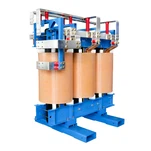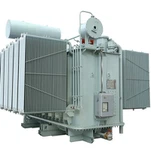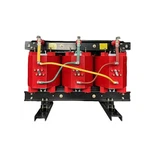


Two quotes land on the same desk for a 2,500 kVA unit. Same voltages, same impedance band, same delivery window - and one is cheaper by roughly a tenth. The buyer signs the lower one. Eighteen months later the plant engineer is asking why the oil temperature climbs faster on the new unit than on the 20-year-old spare it replaced.
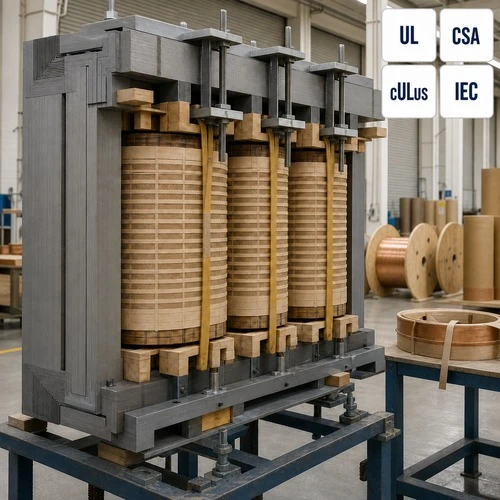
The answer is almost never on the nameplate. It is in the transformer construction behind it: the grade and thickness of the core steel, the current density chosen for the conductor, how hard the coils are clamped, and how much insulating paper the designer decided the job could do without. In a soft market that gap is a rounding error. In a market where a replacement unit can take the better part of a year to arrive, it decides whether you are buying 25 years of service or 40.
What the Nameplate Cannot Tell You
Every transformer arrives with a rating plate, and everything on it is true. Rated power in kVA, voltage ratio, percent impedance, temperature-rise class, cooling class, mass, connection symbol. What the plate does not carry is the information that separates a durable unit from a cheap one: conductor current density, core steel grade, lamination thickness, the number of cooling ducts inside the winding, axial clamping pressure, and whether the tank was ever vacuum tested before oil filling.
The general requirements for power transformers are set out in IEC 60076-1 - the part that covers the functional method of specification and, critically for long service, the vacuum, pressure and leak tests on tanks together with the requirements for liquid preservation systems. A supplier who can walk through those clauses is a supplier who has built to them. A supplier who can only answer rating-plate questions is telling you where the engineering stopped.
That is the part most buyers miss. When you specify nameplate values only, you are not specifying a transformer - you are outsourcing the durability decision to your supplier's cost model.
The Core: Where No-Load Loss Lives Forever
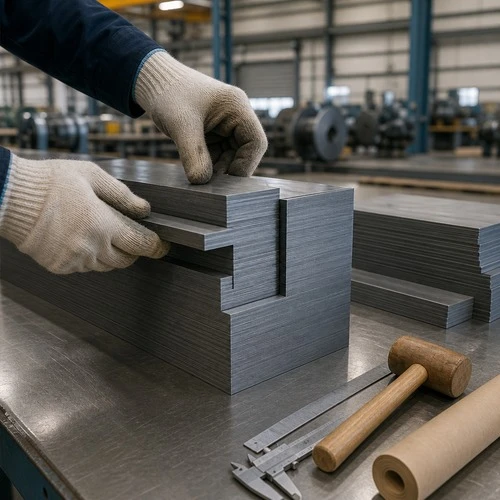
Core loss has two parents. Hysteresis comes from magnetising and demagnetising the steel; eddy loss comes from the fact that the steel is conductive. Both are fought with material and with geometry. Grain-oriented electrical steel is run at roughly 0.23 mm to 0.30 mm thickness, and the thinner the lamination the lower the eddy loss - at a higher material price and with more stacking work in the shop.
Geometry is where cheap construction shows up first. A mitred step-lap joint spreads the flux across several overlapping steps instead of forcing it across a single air gap. On a large transformer core, a joint stacked with poor tolerance shows up twice: excitation current rises, and no-load loss rises with it. Unlike load loss, that number never goes away. It is consumed for 8,760 hours a year for the life of the unit, whether the plant runs at 20 percent load or 100 percent.
Regulators have been pushing in the same direction. The U.S. Department of Energy published amended energy conservation standards for distribution transformers with an effective date of 8 July 2024, and compliance is required from 23 April 2029. Utilities that plan against that date are already writing lower loss limits into today's specifications, because a transformer ordered this year will still be in service when the deadline lands.
There is a price for every point of loss reduction. Pushing flux density down cuts no-load loss and makes the core quieter - magnetostriction is what makes a transformer hum - but it takes more steel, and more steel costs more. That trade is a design decision, and it is invisible on the rating plate.
The Winding: Load Loss, Hot Spots and Short-Circuit Survival
Load loss is largely resistive, so it scales with the square of the current, so it concentrates wherever the conductor is thinnest. Conductor current density is the single most consequential choice in the whole transformer winding design. A lower density means a larger conductor, more copper, a cooler winding and a higher price. A higher density keeps the quote competitive and puts the difference into the hot spot.
Winding topology matters too. Low-voltage windings are commonly built as foil or layer windings, high-voltage windings as continuous disc or interleaved disc, and large units use continuously transposed conductor so that circulating currents between strands cancel each other instead of turning into heat. None of that appears in the kVA figure.
Thermal ageing is where those choices compound. As a working rule of thumb in the industry, insulation ageing roughly doubles for every 6 K the hot spot sits above its rated value with thermally upgraded paper. A design that runs a few kelvin cooler at the same load does not simply run cooler - it buys decades. The transformer winding is where that margin is either designed in or engineered out.
Short-circuit survival is the same story told mechanically. Fault current through the winding produces enormous radial and axial forces, and the winding survives because of clamping pressure, support blocks and preload that still hold after years of thermal cycling. The test code that produces the evidence is IEEE Std C57.12.90-2021, which defines resistance measurements, polarity and phase-relation tests, ratio tests, no-load loss and excitation current measurement, impedance and load loss measurement, dielectric tests, temperature tests, short-circuit tests and audible sound level measurement. Look at that list again: every one of those tests is an audit of construction.
What a Buyer Can Actually Verify
You do not need to stand in the winding shop to judge build quality. You need the records a serious factory produces as a matter of routine, and you need to ask for them before the purchase order is signed rather than after the units are crated. Requesting them from a UL listed transformer supplier is not an unusual ask. It is the normal one.
| Record | What it shows | Why it decides service life |
| Loss test report | Measured no-load and load loss against guaranteed values, corrected to the reference temperature | Reveals core grade and conductor cross-section more honestly than any datasheet |
| Temperature-rise data | Measured top-oil and winding rise and the hot-spot gradient | Sets the thermal ageing rate for the whole life of the unit |
| Transformer core stacking and clamping records | Joint tolerance and the clamping load applied to the coils | Drives no-load loss, sound level and short-circuit strength |
| Tank pressure and leak test records | Vacuum, pressure and leak testing per IEC 60076-1 | Prevents the moisture ingress that kills insulation years later |
| Oil processing records | Vacuum degassing and final moisture content before filling | Determines dielectric strength at first energisation |
| Sound level test | Measured audible sound level against the specified limit | Decides whether the unit passes site noise conditions |
In our own winding shop, the core is stacked on a flat steel platform and checked against a stacking tolerance before the coils are lowered on, and the clamping load is recorded rather than estimated. That is ordinary practice for a factory that expects to run its own tests with a customer standing next to the instrument panel. When an inspector asks for those two records, the only acceptable answer is a folder - not a promise.
Why Construction Matters More in 2026 Than It Did in 2019
Three things changed. Replacement is slower, so a failure is no longer a maintenance event but a production event. Loss economics have been re-examined, because energy prices and efficiency rules have both moved - 200 W of extra no-load loss across 8,760 hours is about 1,750 kWh every single year of the unit's life, before anyone adds the load-loss penalty at peak. And the third change is the one that matters most: construction is the only thing on the list you cannot fix later.
You cannot add copper to a wound coil in the field. You cannot re-stack a core that was assembled on a bench. You cannot retrofit clamping pressure into an impregnated winding. Every decision that separates a 25-year unit from a 40-year unit is made in the factory, weeks before anyone signs a delivery note. That is why the transformer construction deserves more attention in the procurement meeting than the kVA figure on the front page.
How We Document Transformer Construction at Ryan Electric
Ryan Electric builds both dry-type units - cast resin and vacuum pressure impregnated - and oil-immersed power transformers up to 200 MVA, from a 120,000 m² factory in Jiangsu with more than 180 sets of production and test equipment and 37 patents behind the designs. We have been a joint venture partner of Eaton since 2023, and the certification portfolio includes UL, CSA, IEEE, DEKRA, CNAS and CE.
For a buyer the consequence is straightforward. As a UL listed transformer supplier, we ship the evidence with the unit: measured loss results corrected to reference temperature, temperature-rise data, core stacking and clamping records, tank pressure and leak test records and the sound level measurement, in one package instead of three emails. If you are specifying against the 2029 efficiency levels, we will quote guaranteed losses on a construction sheet you can place next to another supplier's - which is the only comparison that means anything.
Ask for the Construction Sheet, Not Just the Price
Next time you compare two quotes for the same kVA, ask three questions. What are the guaranteed no-load loss and load loss at reference temperature? What is the conductor current density and the core steel grade? And which records will be handed over with the routine test report? Every one of those questions is a transformer construction question in disguise, and a supplier who answers all three in a day is describing the transformer you are actually buying.
If you are planning a project and want the construction sheet, the guaranteed loss figures and the test documentation scope in one place, send your rating, site conditions and certification target through ryan-transformers.com - our engineering team will come back with numbers, not adjectives.
About the Author: This article was written by the engineering team at Ryan Electric, a transformer manufacturer in Jiangsu, China, producing dry-type and oil-immersed units for utility, data centre and industrial projects across North America, the Middle East, Southeast Asia and Africa.