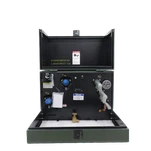


Here is a call we get about twice a year. A 750 kVA unit has been sitting on the pad for nine years, nobody has opened the cabinet since commissioning day, and then one July afternoon the primary elbow flashes over and a feeder goes dark. When the unit comes back to our factory and we cut the tank open, the winding damage is obvious. The winding was also never the problem.
A loose connection, a water path through a gasket, or three summers of loading nobody wrote down did the damage first. For most of this industry's history, that story counted as bad luck. It does not anymore, because NFPA 70B stopped being advice and became a standard. That single change is rewriting what a pad mounted transformer maintenance program has to look like for utilities, industrial plants, and commercial portfolios in North America.
Why Sealed Units Get Skipped
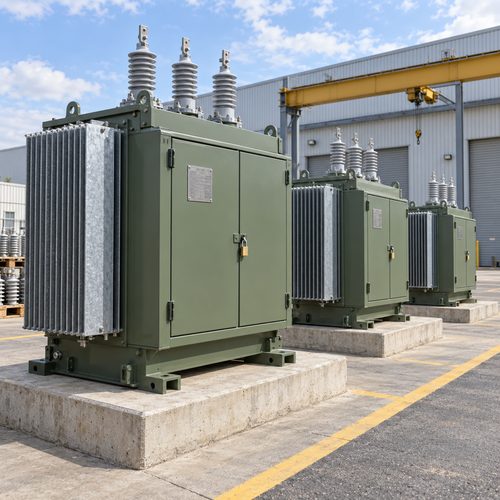
Pad mounted transformers are sold as low-maintenance assets, and the design earns that reputation. There is no conservator, no Buchholz relay, no exposed bushing to wash, and on most ratings no oil sight glass to check. Dead-front construction keeps energized parts behind an enclosure tested to IEEE C57.12.28, the unit is welded shut, and the whole assembly is built to sit on a concrete pad for 25 years. Nothing about that design invites a monthly visit.
The trap is that low maintenance gets read as no maintenance. On a sealed unit you cannot see moisture, you cannot see a slowly loosening elbow, and you cannot see contact resistance climbing a few micro-ohms per year. You can only see the outcome, and by then it is a forced outage rather than a work order.
Thermal aging does not care how sealed the tank is. The loading guide in IEEE C57.91 models insulation aging against winding hot-spot temperature, and the aging rate roughly doubles for every additional 6 K above the reference hot spot. A unit that runs 12% over nameplate through two consecutive summers is not the same asset that was commissioned. This is the part most facilities miss: a transformer inspection checklist that ignores loading records and top-oil temperature never touches the failure mode that causes the most long-term damage.
What Actually Fails on a Pad Mounted Unit
We strip every warranty return. Across the units we have opened, the damage is concentrated in six places, and only one of them is inside the winding.
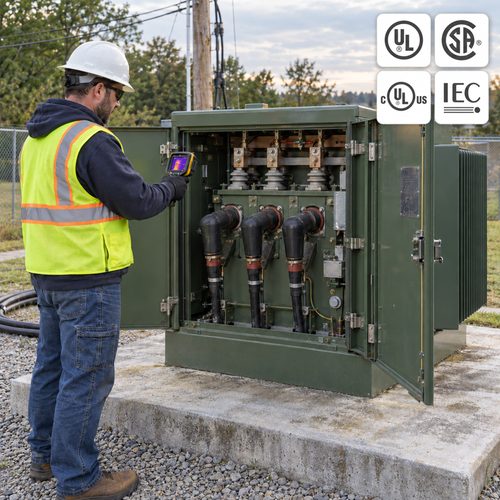
- Elbow and bushing interfaces. Thermal cycling relaxes torque on the threaded connection. Contact resistance rises, the joint runs hotter, the torque relaxes further. It is a slow runaway that an infrared scan with the unit loaded will show in seconds.
- Lightning arresters. Silent until a surge arrives, then they either protect the unit or fail. Age, contamination and physical damage are the only visible warnings.
- Moisture paths at gaskets and handholes. Compression set, UV exposure and repeated thermal cycles open a path. Water does not need a hole in steel; it needs a joint.
- Tank, base and pad corrosion. Road salt and coastal air attack the coating system and the tank base first, usually where the concrete pad traps moisture.
- Wildlife. Rodents through the LV compartment, birds and animals bridging terminals. Cheap to prevent at order stage, expensive after an outage.
- Duty, not faults. Harmonic-rich loads, unbalanced phase loading and sustained overload push hot-spot temperature past what the nameplate assumed. The insulation degrades; the fault is only the last event.
When a three-phase pad mounted unit arrives back at our factory, we cut the tank before we test anything. Nine times out of ten the winding is a casualty, not a cause, and the trail leads back to a connection, a water path, or a load profile nobody monitored.
NFPA 70B Stopped Being Advice in 2023
NFPA 70B was a recommended practice for electrical equipment maintenance for decades. The 2023 revision turned it into the Standard for Electrical Equipment Maintenance, written in mandatory language rather than suggestions, and the current 2026 edition was issued in November 2025 and took effect on 9 December 2025. The document itself is on the NFPA 70B standard page, where NFPA also states its scope plainly: preventive maintenance for electrical systems and equipment in industrial plants, institutional and commercial buildings, to prevent equipment failures and worker injuries.
The companion document moved at the same time. The NFPA 70E edition now current took effect on 6 May 2026, and it is still the framework OSHA leans on through 1910 Subpart S and 1926 Subpart K for shock, arc flash and arc blast protection. Read together, 70B defines what you must do to the equipment and 70E defines how a person may approach it. A pad mounted unit sits at the intersection of both.
Here is the honest engineering caveat, and we would rather state it than oversell it: NFPA 70B is not self-enforcing, and no inspector is walking neighborhoods looking for maintenance logs. What the change did was give insurers, auditors, authorities having jurisdiction and OSHA investigators a consensus yardstick. If a unit fails and someone asks what program was in place, "we checked it when it hummed louder" is no longer a defensible answer.
For fleet owners, the practical effect is that maintenance stops being a cost line and becomes a documented process with intervals, criteria and records. Every part of that is cheaper to build once than to reconstruct after an incident.
A Pad Mounted Transformer Maintenance Program You Can Run
You do not need a substation-grade program for a pad mounted fleet. You need a short list of tasks with fixed intervals and a clear alarm criterion for each. This is the structure we hand to utilities and industrial customers, and it holds up whether the unit is a 75 kVA single phase on a residential loop or a 2,500 kVA three phase unit feeding a plant.
| Task | Interval | Alarm criterion we work to |
| Cabinet visual, security and moisture check | Monthly | Open door seal, water staining, debris or insect nest, missing padlock |
| Infrared thermography (loaded scan) | Annual; quarterly for critical or >1 MVA | Any connection more than 10 C hotter than comparable neighbors |
| Fluid sampling: moisture, BDV, DGA | Annual; 6-monthly for >2 MVA or >15 years | Two consecutive samples trending the same direction, or gas above IEEE C57.104 attention values |
| Loading and top-oil record review | Monthly | Repeated peaks above nameplate without documented thermal analysis |
| Elbow and terminal torque verification | Every de-energized switching, minimum 3-yearly | Any joint found below specified torque, or showing tracking marks |
| Grounding and pad bonding continuity | Annual | Any measured resistance rise against commissioning baseline |
| Coating, tank base and pad corrosion | Annual | Coating breach at the pad line, or rust bleed at welds |
| Insulation resistance, turns ratio, winding resistance | At commissioning, after through-fault, or on relocation | Deviation beyond 5% between phases or against the factory baseline |
| SFRA | After fault, repair or transport | Any shift in the frequency response trace against the original fingerprint |
Two rules make the table work. First, every interval must survive a staffing shortage; a monthly visual check that actually happens beats a quarterly program that gets postponed. Second, every task needs a numeric trigger, not an opinion. In our inspection reports we flag any connection running more than 10 °C hotter than its neighbors on the same unit under comparable load, and we treat any oil moisture result that has risen two consecutive samples as a trend worth investigating even when it is still inside the limit.
If you are specifying units now and want the maintenance program to be possible later, mention it early. A pad mounted transformer manufacturer can only fit a fluid sampling valve, a drain and fill valve, or a pressure relief device while the tank is being built. Ask us for the model-specific interval sheet with the order and you avoid designing the program around what the hardware allows.
What Is Worth Testing, and What to Skip
Testing is where maintenance budgets leak. Most pad mounted fleets do not need a laboratory schedule; they need to know which tests change a decision.
Dissolved gas analysis. The highest-value test on an oil-filled unit, and the one most often impossible on pad mounted hardware, because many sealed units ship without a sampling valve. If DGA matters to your reliability program, specify the valve and the drain and fill fittings at order stage. On units that have them, annual sampling with a six-month interval for critical or older units gives a usable trend.
Infrared thermography. Cheap, non-intrusive, and it catches the connection failures that cause most emergencies. Scan with the unit loaded; a scan taken at 20% load tells you almost nothing.
Turns ratio, insulation resistance and winding resistance. Baseline them at commissioning, then repeat after any through-fault, relocation or tap change. There is little value in running them annually on a healthy sealed unit that no one has touched.
SFRA. A diagnostic after an event, not a scheduled test. If a unit has taken a fault or been moved, frequency response analysis tells you whether the core and windings are still where they should be mechanically.
What to skip. Do not open a sealed tank to look inside. Breaking the seal on a healthy unit introduces the moisture you were trying to avoid, and it resets the clock on every gasket in the assembly. Corrosion inspection happens outside the tank, and that is where the actionable findings are anyway.
Design Choices That Decide Your Maintenance Cost
Fifteen years of fleet cost is decided in about twenty minutes of specification writing. These are the details that separate a unit that can be maintained from one that can only be replaced.
- Enclosure integrity. The IEEE C57.12.28 conformance requirements exist to deliver long field life with minimum maintenance and positive safety features. Confirm your supplier tests to the current edition: the IEEE C57.12.28-2023 standard covers conformance tests and requirements for above-grade pad-mounted enclosures containing apparatus energized above 600 V.
- Sampling and drain provisions. Fluid sampling valve, drain and fill valve, and a pressure relief device where the design supports one. All three must be in the drawing set before fabrication.
- Coating system. For coastal, road-salt and industrial atmospheres, specify the coating system rather than a color. We build to extended salt-spray exposure for these projects because the tank base is where corrosion always starts.
- Access and documentation. Hinged doors with hold-open, an LV compartment a technician can actually reach, and a nameplate that carries serial number, routine test reference and tap schedule. Retro-documenting a fleet is far more expensive than printing the plate correctly.
The most common gap we see is not a missing option. It is a unit specified for a maintenance program that nobody had budgeted for, which means the program quietly does not happen. Asking the pad mounted transformer manufacturer for the interval sheet at quotation stage forces that conversation while it is still free.
What Ryan Electric Sends With Every Unit
Our factory in Jiangsu has delivered pad mounted and three-phase distribution transformers to North American utilities, Canadian industrial sites and projects across Southeast Asia and the Middle East. As an Eaton joint venture partner with UL, cULus, CSA, IEEE and DEKRA certifications in our portfolio, we treat the documentation as part of the product: routine test reports, nameplate records, conformance evidence and a model-specific inspection interval sheet.
The engineering behind that is not exotic. We build enclosures tested for tamper resistance and long field life, we place sampling valves and pressure relief where a fleet actually needs them, and we keep weld, vacuum and test records that a buyer can audit years later. That matters more than any brochure claim, especially in a market where you may be keeping the same units in service until 2050.
If you are rebuilding a maintenance program around the 70B framework, or specifying new pad mounted units and want the hardware to support it, send your rating, voltages and site conditions through ryan-transformers.com. We will come back with a drawing set, the interval sheet for that model, and a realistic schedule. If your existing fleet is the problem, tell us the kVA and vintage and we will tell you which tests are worth running on those specific units.
About the Author: Written by the engineering team at Ryan Electric, an Eaton joint venture partner and UL/CSA-certified transformer manufacturer in Jiangsu, China, supplying dry type, oil immersed and pad mounted transformers to utility, data center, industrial and renewable projects across North America, Southeast Asia, the Middle East and Africa.