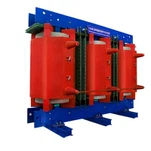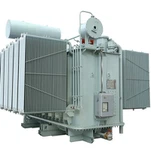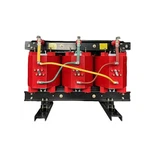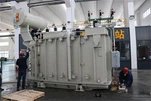


A solar EPC in Malaysia ordered a pad mounted transformer, a ring main unit and a low-voltage panel as three separate packages. All three arrived on site in the same month. Then the crew waited eleven days for concrete to cure under the ring main unit, because nobody had checked the switchgear cable box height against the foundation drawing. Nothing was defective. The project was simply late.
That is the problem a compact substation is designed to remove. One enclosure, one foundation, one tested unit leaving the factory with the medium-voltage switchgear already wired to the transformer. Whether the promise holds up depends almost entirely on what gets written into the specification before the purchase order is placed.
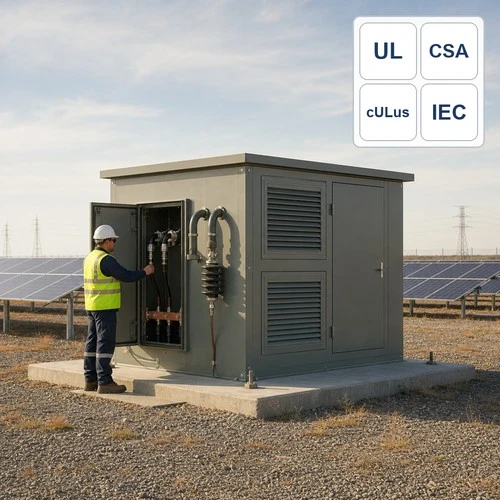
What a Compact Substation Actually Is
A compact substation - also written as a prefabricated substation or packaged substation - puts medium-voltage switchgear, a distribution transformer and low-voltage distribution into a single factory-assembled enclosure. The unit leaves the works cable-connected and ready for site termination, rather than as three loose packages that have to be coordinated by whoever is on site that week.
The governing document for this equipment outside North America is IEC 62271-202. It covers these assemblies for rated voltages above 1 kV and up to and including 52 kV on the high-voltage side, in walk-in and non-walk-in versions, for service frequencies up to 60 Hz. The 2014 edition tightened two areas that matter in practice: the temperature-rise test method for dry-type transformers inside an enclosure, and the internal arc test requirements, which were aligned with IEC 62271-200. The scope and revision history are set out on the IEC 62271-202:2014 standard page.
Why the enclosure changes the transformer is worth understanding. A cast-resin transformer rated in free air is not rated the same way once it sits inside a steel box with louvres. The load factor calculation for a transformer in an enclosure, including Annex DD of the standard for liquid-filled units, exists because heat that cannot leave the enclosure raises the winding temperature at the same kVA. Two identical transformers, one in free air and one inside an assembly, do not share a rating. That single fact is where under-specified projects get into trouble two summers after commissioning.
Where the Schedule Savings Really Come From
In our works in Haian, the assembly is wired, busbar-connected, earthed and routine-tested on the shop floor with the enclosure doors still off. The customer receives one unit with one set of test records, one lifting plan and one set of terminal drawings.
The site side is where the difference shows. One foundation instead of three. One crane day instead of three. One earthing connection between the enclosure frame and the site earth grid instead of an interface argument between three suppliers. When we ship these assemblies to solar and data center projects, the commissioning week that disappears is usually the messy one - the week where switchgear, transformer and LV panel each need their own witness and their own paperwork.
Here is the part most buyers miss: the saving is not mainly about shipping. It is about the number of contractual interfaces. Three packages mean three delivery dates that can slip independently, three sets of cable-box dimensions that have to agree, and three warranty owners who can each point at the other two. A prefabricated substation collapses all of that into one.
The question we get most often from EPCs in Southeast Asia is not about the transformer at all. It is about who owns the interface between the enclosure and the site earthing grid - and that answer belongs in the specification, not in a site meeting three weeks before energization.
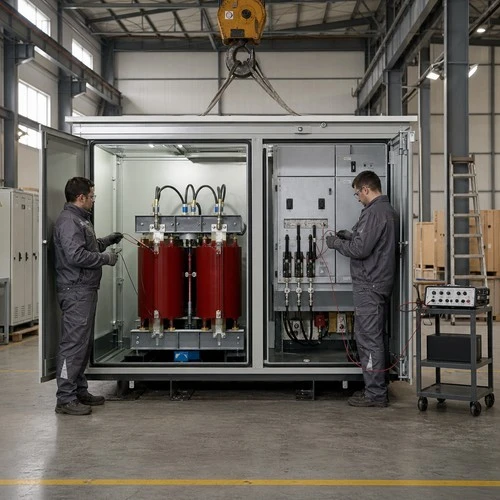
What to Specify: The Five Items That Decide Review
Most quotations that come back non-compliant fail on the same five lines. Put them in the RFQ in this order and the comparison becomes straightforward.
| Item | What to write | Why it decides the review |
|---|---|---|
| Voltage and frequency | HV class (11 / 22 / 33 kV), LV 400 or 415 V, 50 or 60 Hz | Sets dielectric levels, tap range and test frequency; a 50 Hz design cannot be re-rated for a 60 Hz grid without a flux check |
| Transformer inside | Rating, cast resin or liquid-filled, insulation class, average winding rise | Governs enclosure load factor, ventilation area and which temperature-rise test method applies |
| MV switchgear | Busbar rating, short-time withstand current and duration (20 kA for 3 s is a common utility requirement), interlocks, cable entry | Decides cable box height, foundation depth and the short-circuit evidence you must collect |
| Enclosure | IP rating, internal arc classification, coating system, corrosivity category | Determines whether the unit survives coastal or desert sites and whether it clears utility or insurer review |
| Interfaces | Earthing points, LV outgoing arrangement, protection and metering, communications | These generate site change orders when they are left to the installer |
Two of these deserve more than a line item. Short-time withstand current drives both switchgear cost and internal arc classification, and internal arc classification is the number an arc-flash study will reference. Incident energy is calculated using IEEE 1584-2018, and no calculation rescues a unit whose tested arc classification was never declared. Ask for the classification before the study, not after.
The second is the coating system. An enclosure that passes a factory salt-spray cabinet and then spends fifteen years 200 m from the sea is a different engineering problem. For coastal and desert projects we specify a coating system and a corrosivity category rather than a colour, and the coating thickness readings go into the routine test file with photographs.
Certification: The Evidence to Collect Before Payment
The unit is a type-tested assembly, not a collection of certified parts. The type tests belong to the assembly: dielectric tests on the enclosure, temperature rise with the transformer in place, degree of protection, and the internal arc test whenever an arc classification is claimed. Routine tests then apply to the specific unit you are buying.
Build the payment schedule around those documents - type test reports, routine test records whose serial numbers match the nameplate, transformer routine and type reports, and the earthing continuity record. If the unit is going to the United States or Canada, the transformer inside still needs its own listing evidence. A UL or cULus listing for a transformer does not automatically extend to the assembly built around it.
Energy efficiency is the other document set buyers now ask about earlier. The U.S. Department of Energy amended the energy conservation standards for distribution transformers, and compliance with the amended standards is required on and after 23 April 2029. The scope rules and the compliance date are published on the DOE distribution transformers page. A unit specified today against a 25-year service life should not be ordered to a standard that expires before it is installed.
Compact Substation or Pad Mounted Transformer?
They are not competitors. They are different answers to different site constraints, and specifying the wrong one is expensive in both directions.
| Decision factor | Compact substation | Pad mounted transformer |
|---|---|---|
| Where the MV switchgear lives | Inside the same enclosure | Separate, or in a utility-owned cabinet |
| Typical use | Industrial plants, solar and BESS blocks, data center yards, commercial developments | Utility distribution, residential and commercial service |
| Site work | One foundation, one lift, one termination | Transformer plus separate switchgear foundations and cabling |
| Access | Walk-in versions allow maintenance from inside | Maintained from outside |
| Certification route | Type-tested assembly to IEC 62271-202 | Transformer to the IEEE C57 series with UL / CSA listing |
| Change management | One supplier interface | Interfaces split across suppliers |
If the site is a utility distribution point where the utility owns the switchgear, a pad mounted transformer is the right answer and the assembly simply duplicates cost. If the site needs MV switchgear, protection and LV distribution in one footprint - a solar block, a battery container yard, an industrial plant extension - the assembly is usually cheaper to install even when the equipment itself costs more.
Questions Buyers Ask Us Before an RFQ
The recurring one is whether the transformer can be uprated later. Inside an enclosure, it cannot. Enclosure load factor and ventilation are fixed with the transformer, so a 1000 kVA unit is not a 1250 kVA unit waiting for a larger fan.
The second is whether one supplier can cover both the assembly and the transformer listing for North America. This is where the manufacturing base matters. Ryan Electric has built transformers and packaged assemblies since 2007 and has been an Eaton joint-venture partner since 2023, working from a 120,000 m² facility with 37 registered patents - which is what allows the transformer listing evidence and the assembly type test file to be issued together instead of traded between two vendors.
The third is lead time. Assembly type tests are not repeated per order, but the transformer inside still carries its own production slot. Ask what is actually on the critical path: for most orders of this type it is the transformer, not the enclosure.
Public references make the point better than a brochure. Our units are in service with a utility customer in Kenya and with mining operations in Canada, and our cast resin range has been supplied to plant projects in the Middle East - the same engineering group that designs, assembles and routine-tests these substations.
Send four things and the quotation comes back comparable: the single-line diagram, the site corrosivity or environmental conditions, the required internal arc classification, and the transformer rating with its insulation class. Without those four, every supplier assumes something different, and the cheapest quotation will be the one that assumed the least.
Review our compact substation range and the solar substation configuration for the standard builds, or send those four inputs to ryancustomerinquiry@redq.cc and our engineering team will return a specification review with the relevant type test file attached.
About the Author
This guide was prepared by the packaged substation engineering team at Ryan Electric, based on factory assembly, routine testing and site commissioning support for prefabricated packages supplied to utility, solar, data center and industrial projects. Questions about enclosure load factor, internal arc classification or a specific IEC 62271-202 type test file can be sent to ryancustomerinquiry@redq.cc.