

AI Data Center Transformer Demand Is Rising Fast - What Specifiers Need to Know in 2026
AI data center transformer demand is the single strongest force reshaping the power equipment market right now. Last week, Iberdrola agreed to pay $2.3 billion for an 80% stake in Finnish utility Caruna, and the buyer's own explanation was electricity demand from new data centers and industrial customers. One deal, read one way: the power sector is reorganizing itself around AI infrastructure, and the transformer sits at the center of that reorganization.
Here's the part that matters for specifiers: this is not a distant trend. It changes what you should be specifying, how fast you can get delivery, and which suppliers can actually back their quotes. This article walks through the demand picture and the practical specification changes it triggers - grounded in events from the past few weeks.
What Is Driving the AI Data Center Transformer Surge?
The trigger is simple: AI workloads consume power in a way legacy IT never did. A single GPU rack can draw more than ten times the power of a conventional server rack, and every one of those racks needs stepped-down, regulated, reliable power at the point of use.
Transformer load growth from this source is compounding with two older pressures: aging distribution grids and the U.S. Department of Energy's 2026 efficiency rules, which push older, less efficient units into early replacement. Three forces, one direction.
Grid vendors are reacting in public. S&C Electric's expanded partnership with Argonne National Laboratory is aimed squarely at large-scale load customers and AI data centers. When equipment makers restructure R&D around AI load, specifiers should treat the demand trend as structural - not cyclical.
How AI Workloads Change the Transformer Spec
The first thing that changes is the K-factor. AI power electronics - server PSUs, UPS front ends, cooling drives - inject harmonics that a standard transformer is not designed to absorb. For data halls today, we routinely quote K-13 or K-20 ratings instead of the K-1 that was common a decade ago.
Secondary voltage and redundancy follow. North American halls typically step down 480 V to 208/120 V; a growing share of AI designs asks for dedicated 400 V or 480 V distribution with N+1 or 2N transformer paths. That means more units, smaller per-unit rating, and a spec that must be frozen early - because every change ripples into switchgear and UPS sizing.
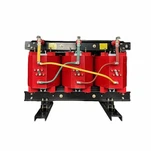
Thermal design matters too. A dry type transformer for data center duty in a sealed electrical room has limited air exchange; we design for 80°C rise (Class F) as standard and derate when ambient exceeds 40°C. Buyers who skip the ambient check end up with nuisance overload trips in the first summer.
|
Spec Item |
Legacy IT Hall |
AI Hall (2026) |
|
Rack power density |
8–15 kW per rack |
40–100+ kW per rack (liquid-cooled) |
|
Transformer K-factor |
K-1 to K-4 |
K-13 to K-20 |
|
Redundancy |
Partial N+1 |
Full N+1 or 2N paths |
|
Typical unit rating |
1,500–2,500 kVA |
2,500 kVA+, multiple paths |
|
Secondary voltage |
480→208/120 V |
480→208/120 V or 400 V |
|
Efficiency driver |
First cost |
DOE 2026 tier + total cost of ownership |
The table shows typical ranges, not a standard - site specifics vary. But the direction is consistent across every AI data center spec we have quoted this year.
The Certification Layer Nobody Can Skip
North American data center projects have no tolerance for certification gaps. UL 1561 for dry-type units, CSA C22.2 for Canadian sites, and the DOE energy-efficiency tiers all need to be verified before you issue a PO - not after the container is on the water.
This is where many buyers get stuck. A factory can show you a test report from its own lab, but if the unit is not covered by a valid UL listed transformer supplier certificate for the exact model and rating, the project engineer will reject it at submittal. We see this every quarter: a well-priced quote that dies in review because the certification scope does not match the model number.
Check the DOE compliance path at the same time. The U.S. Department of Energy's 2026 efficiency standards changed minimum efficiency levels for distribution transformers; units that were legal in 2024 may no longer be eligible for U.S. projects. Confirm the efficiency class in the quote, in writing.
Supply-Side Reality: Factories Are Expanding, But Not Fast Enough
Global capacity is growing. Hitachi Energy's $300 million investment to expand its Hefei, China transformer plant is one of several announced this year, and our own lead times for UL-listed dry-type units have come down from their 2024 peak. But capacity additions take 18 to 36 months to become shippable transformers.
Meanwhile, transformer load growth from AI, grid upgrades, and DOE-driven replacement keeps absorbing new capacity. The practical consequence: production slots are still allocated on a first-come basis, and buyers who lock designs early get the delivery windows. Waiting for prices to soften is a strategy that has not worked in this cycle.
Read our breakdown of 2026 transformer lead times if you are planning a Q1 2027 energization - the planning math has not changed, even as headlines about new plants multiply.
What We Tell Specifiers at Ryan Electric
A hyperscaler consultant called us last month with a spec that looked complete: 4 × 2,500 kVA, K-13, UL 1561, 480→208/120 V. What was missing? The ambient temperature inside the sealed electrical room (38°C), the ride-through time of their UPS, and the fact that the building owner wanted a 150% overload for 30 minutes during generator testing.
We build both cast resin and VPI dry type transformer for data center lines, all UL-listed, and we test every unit with routine factory tests plus partial discharge measurement before shipment - a practice aligned with our partnership with Eaton since 2023. That last point matters more than marketing: it means the loss figures and temperature rise on the test report come from a CNAS-accredited lab, not a spreadsheet.
If your project is in the design stage, send us the single-line diagram and the cooling design. Our applications engineers will review the transformer schedule for free - including K-factor, redundancy, and certification scope - before you send the RFQ anywhere else.
The Bottom Line
The market signal is unambiguous: AI data center transformer demand is structural, capacity is expanding slower than load, and certification compliance has become the gating factor in North American procurement.
Specify for the real load profile, freeze the design early, verify UL and DOE compliance in writing, and choose a supplier whose factory, test lab, and certificate scope are all verifiable. That is the short version of everything above.
Have a data center project in North America or Southeast Asia? Get a free technical quote → Contact our team and include your transformer schedule - we will reply within one business day.